• THE FASCINATING DIFFERENCE IN PERFORMANCE REVIEWS BETWEEN GENERATIONS

    by Neal McNamara on Mar 4, 2016 8:00:00 AM
     You hear it often: people hate going through the performance review process at work. Managers hate how much time it takes, and employees feel stressed going through it.

    Those feelings, however, are imprecise and often based on stereotypes. In an attempt to find out more about attitudes toward reviews, we polled over 1,000 professionals to find out how they feel about the review process. In particular, we wanted to find out how perceptions of performance reviews differ across generations – baby boomers, Generation X, and millennials. Here’s the jist of what we found:

    • 37% of respondents said the performance review process is outdated
    • 42% of respondents felt that something important was left out of their performance review due to bias
    • 41% told us they do NOT receive a pay increase after a positive review
    • 64% said they wanted their review tied to compensation
    • Millennials fear performance reviews the most, while baby boomers are more comfortable with them
    • Millennial respondents were significantly more stressed by the review process than Gen X or baby boomers


    The Fascinating Difference In Performance Reviews Between Generations by TINYpulse

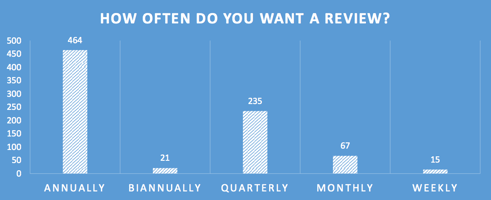
    Most said that an annual review is best, but 24% said they would prefer a quarterly review.


    Millennials vs. Everyone Else

    There’s one clear takeaway from the poll: millennials don’t like traditional performance reviews. Compared to other generations, millennials are more likely to fear annual reviews, more stressed out by them, more likely to feel that reviews are biased, and more open to a change in frequency of reviews.

    According to Pew, millennials are now the largest demographic group in the workforce, so we believe they will force a change in how organizations conduct reviews. Change will come as millennials attain management-level positions, but also as new technology enables organizations to find new ways to handle reviews.

    The Fascinating Difference In Performance Reviews Between Generations by TINYpulse

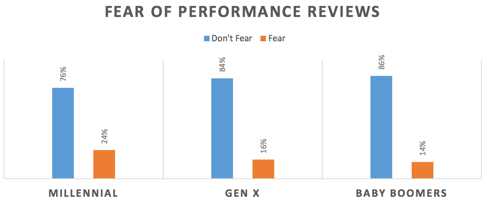
    24% of millennials fear going into their performance review, compared to 16% of Gen X and 14% of baby boomers.


    The Fascinating Difference In Performance Reviews Between Generations by TINYpulse

    24% of millennials fear going into their performance review, compared to 16% of Gen X and 14% of baby boomers.


    The Fascinating Difference In Performance Reviews Between Generations by TINYpulse

    Millennials want to have their review quarterly (28%) or annually (38%), while baby boomers (58%) prefer the standard annual review.


    The Fascinating Difference In Performance Reviews Between Generations by TINYpulse

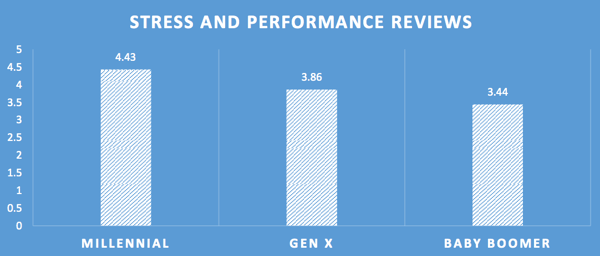
    Millennials are on average more stressed (4.43) about performance reviews compared to Gen X (3.86) (p = .009) and baby boomers (3.44) (p < .001). Measurements on a scale of 1 — 10.


    RELATED POSTS:

  • AN ANNOYING COWORKER CAN HELP STRENGTHEN YOUR LEADERSHIP SKILLS

    by Robby Berman on Aug 25, 2016 1:00:00 PM

    There’s a reason that so-and-so ticks you off. The key is to figure out why, and use that information to grow as a person, and maybe even pick up valuable personal skills along the way. It’s a three-step process.

     01. Put a face to the aggravation

    If you have someone in mind already, skip to step 2. Otherwise, during the workday, stresses can accumulate little by little without you being aware of each one specifically — maybe you haven’t noticed that somebody is, in fact, bugging you. Is there someone you find you’re complaining about to friends and coworkers? Is there someone with a gift for getting you off task or stuck? Is there someone who makes you decide to wait for the next elevator?

    They are your nemesis (for the purposes of our exercise).

    02. Figure out what it is about them that annoys you

    Identify the precise negative emotion the person elicits in you and why. Does the person make you aggravated, feel inferior, disappointed?

    Next, figure out the precise behavior in that person that triggers that emotion. Do they make you wait all the time? Do they interrupt you when you speak? Is their work bad?

    03. What does your dislike of the person tell you about yourself?

    It’s a sad/disturbing/embarrassing fact of life that what we dislike in others is often a trait in ourselves with which we struggle. That person you can’t stand is an awesome tool for putting your finger on something that you, deep down inside, know you have to work on.

    Maybe someone’s tendency to steal the spotlight nags at your worry that you’re not being noticed. Maybe they have some characteristic you’re afraid you have. Maybe they’re just adept at pressing one of your buttons regarding a secret insecurity of yours.

    Here’s where the win is: instead of being annoyed by the person’s trait, consider it a wake-up call to work on what it triggers in you. Aha!

    In the end, you’ll likely find your dislike of the person cooling off as you work on what they’ve exposed in you. The person may still be a jerk, but you won’t care. You’ll be free and better off for their annoying presence in your workday.

  • 4 THINGS MILLENNIALS REQUIRE WITH PERFORMANCE REVIEWS

    4 THINGS MILLENNIALS REQUIRE WITH PERFORMANCE REVIEWS

    chrisratigan
    by Chris Rhatigan on Apr 27, 2016 8:00:00 AM

    While most employees don’t like performance reviews, those from the millennial generation particularly resent them. Our report, The Truth Behind Performance Reviews, found that the vast majority of millennials think the performance review process needs a complete overhaul.

    Poor performance reviews are driving good employees away. According to a study of six companies by Ivey Business Journal, having a quality performance review process that includes frequent, relevant feedback is the number one driver of engagement for millennials. We’ve identified some key reasons millennials are turned off by performance reviews and how to address those issues.

    Lack of Frequency

    The days of the annual performance review are over. Even large corporations like GE — known for its rank-and-yank tactics and its merciless CEO, Jack Welch — are scrapping this system in favor of more frequent feedback, according to The Atlantic. Millennials have consistently reported that this lack of feedback leads to less growth, as they don’t know how they can improve. In fact, 74% of millennial employees said they feel “in the dark” about how well they’re performing, according to a TriNet study.

    While the standard annual performance review is an hour, more often but shorter feedback sessions on specific topics would work better. You can also use electronic tools to measure performance week over week, eliminating the need to sort through performance review data yourself.

    One-Way Communication

    About one-fourth of millennials said they’ve called in sick to avoid a performance review and about one in eight said a performance review made them cry, according to TriNet. And who can blame them — does anyone want to endure an hour of criticism?

    Instead, millennials want a more informal and positive atmosphere. Approach performance reviews more like a conversation and focus on the positives whenever possible. Allow for employees to evaluate their own performance and discuss any issues they might have with feedback. Some companies have created ways for employees to request feedback whenever they want it.

    Too Vague

    Another major issue with performance reviews is that the feedback given is too vague. Our study found that 38% of employees thought that feedback needed to be more oriented toward metrics and goals. This avoids employees thinking that the manager is biased against them and keeps the process objective.

    Employees should know what your expectations are from the start. Make your feedback specific and measurable. This way employees can actually improve their performance and become stronger professionals.

    The same goes for positive feedback. The occasional “nice job” isn’t enough. Tell employees exactly what they’re doing well. Not only will they keep doing it, but they’ll feel like they’re making a significant contribution.

    The old system of performance reviews doesn’t work well for most employees. While millennials have some of their own ideas about what could make performance reviews better, it’s safe to say that most employees would welcome some changes.


  • 8 REASONS WHY 360 REVIEWS DON’T WORK LIKE THEY’RE SUPPOSED TO

    sabrina-son

    by Sabrina Son on Aug 25, 2016 8:00:0

    360-degree reviews are gaining traction in how organizations measure their employees’ strengths and track development — and it’s understandable why.

    Traditional performance appraisals have a bad rap as a pointless, frustrating tool. Consider what our research found when we asked both managers and employees for the number one reason they dislike performance reviews:

    • 31% managers and 17% of employees think they’re too time-consuming

    • 12% of managers believe they’re too much of a one-way conversation

    • 11% of employees think managers can be biased

    Given these facts, the 360-degree survey appears to be a godsend. These reviews ask employees across the organization, including peers, supervisors, and subordinates, to assess the employee. Some reviews may even go outside the organization and ask clients or customers for feedback.

    So what’s the catch? While 360-degree surveys are an attractive solution to the performance review crisis, they come with their own set of problems. Here are eight disadvantages to relying on a 360 review process:

    01. Focus on the individual

    In a world that increasingly values collaborative work and project teams, 360-degree reviews are out of sync because they measure individual performance.

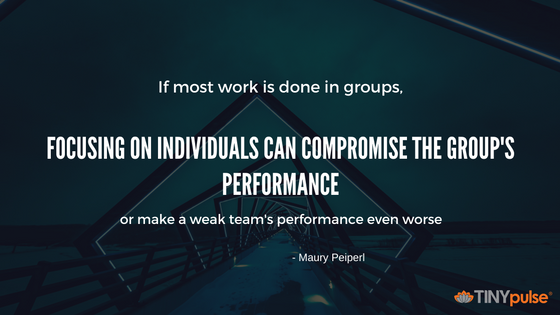
    Maury Peiperl, a researcher from Cranfield University in England, found in his research that both high-performing and low-performing teams are unenthusiastic about peer appraisal systems for that reason. He notes that “if most work is done in groups, focusing on individuals can compromise the group’s performance or make a weak team’s performance even worse.”

    If the bulk of an employee’s work is collaborative, it makes more sense to evaluate the group performance, rather than focusing on the individual.
    360 performance reviews

    02. Personality over performance

    While crowdsourced feedback can be helpful in understanding an employee’s complete performance, it’s inherently flawed because it’s not coming from people trained to evaluate other people.

    Often, survey questions elicit opinion-based answers rather than performance-based responses, so personality problems can worm their way into a performance review. Coworkers who are competitive could exploit the review to complain about issues that aren’t necessarily related to an employee’s performance or development. Employees who don’t like a manager’s leadership style may use the review as an avenue to seek retribution. In either case, the review favors personality-related comments over performance-related feedback.

    03. No follow-up

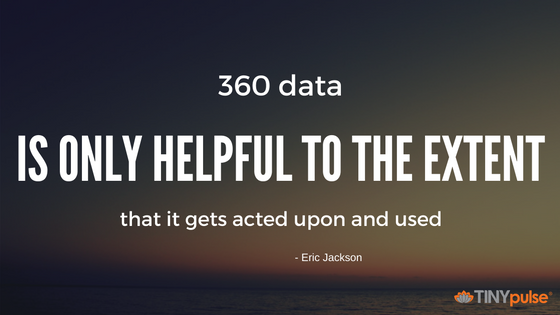
    Feedback without follow-up is useless, something that’s true of all performance reviews.Eric Jackson, the founder of Ironfire Capital LLC and a management expert, notes that “360 data is only helpful to the extent that it gets acted upon and used. The majority of programs we see simply give the feedback and then it gets swiftly forgotten.”

    Unfortunately, the sheer number of people involved in the review process and the frequency of the review cycle limits the possibility for follow-up. An employee might read the feedback they receive, hit delete, and give it no more thought.
    360 reviews

    04. Poorly structured reviews

    Marcus Buckingham, an expert on performance management, underscores a structural problem with 360 reviews. Most 360 reviews rely on a similar formula: creating a set of competencies and behaviors, then rating the employee on those aspects of their performance.

    Buckingham argues that asking reviewers to consider common statements like “this employee sets a clear vision for the team” actually results in subjective data because the reviewer invariably ends up comparing themselves to the person being reviewed. Each rater brings their individual biases into the process, skewing the data in different directions.

    05. Lack of context

    Workplace culture matters when it comes to reviews. If problems are endemic to your culture, this might surface in reviews, which become less about the employee and more about the mood of the company. For example, in a company where rounds of layoffs have lowered morale, a supervisor might be negatively reviewed by subordinates who feel the supervisor isn’t doing enough to prevent layoffs, even if that’s beyond the person’s power.

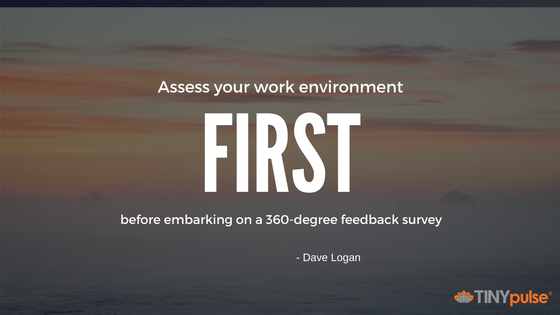
    Management consultant Dave Logan suggests assessing your work environment first and feeling secure in that assessment before embarking on a 360-degree feedback survey.
    360 degree review

    06. No ownership

    Because the 360-degree review process involves so many stakeholders by definition, no one person or department takes ownership of the process. Even if the human resources department is overseeing the rollout of the survey, they can’t be expected to follow up with every single employee. This seriously hampers the effectiveness of the review to act as a development tool, giving it the feel of a one-time pulse check.

     07. Unmeasurable success

    Unlike annual (or semiannual) performance reviews issued by a direct supervisor, 360 reviews aren’t structured for goal setting, meaning there’s no real way to measure an employee’s success in addressing shortcomings or surpassing expectations from a previous review cycle.

    Unless there’s someone who is sitting down with each employee and comparing multiple sets of reviews over time, the reviews are essentially disconnected from any goals the employee may have in the same time period.

    More than likely, the reviewers have no insight into what the employee wanted to accomplish — and are only rating the employee on what they did, not what they had set out to do.

    360 reviews

    08. Time-consuming process

    Snapshot data can be helpful in capturing trends, but 360-degree reviews are a lengthy process. Asking five or more people per employee to fill out a survey adds up over time, especially if reviews are given multiple times in a year. Moreover, the review’s value diminishes if it’s not a tool that produces measurable results and helps develop employees.

    While traditional supervisor-to-subordinate reviews do get a bad rap from employees, you may want to think before you switch over to a totally crowdsourced format. Peer-to-peer appraisal can have a place in your review process, but these time-consuming, subjective, and loosely structured surveys don’t necessarily produce results that managers can use to develop and motivate employees.

    They also don’t measure the true indicators of performance that employees say they want in a review. While employees might be happier to get feedback from multiple sources in the short term, these crowdsourced reviews will hurt them and your organization in the long run.

     Editor’s Note: This post was originally published in July 2015 and has been updated for freshness, accuracy, and comprehensiveness.