
• What 12,000 Employees Have to Say About the Future of Remote Work

    AUGUST 11, 2020 By Adriana Dahik, Deborah Lovich, Caroline Kreafle, Allison Bailey, Julie Kilmann, Derek Kennedy, Prateek Roongta, Felix Schuler, Leo Tomlin, and John Wenstrup     

    Although the COVID-19 pandemic has led to economic, health, and social devastation, it has also created an unprecedented opportunity: to run the world’s biggest-ever workplace experiment. This experience is yielding fascinating insights that have significant implications for the way we should organize work.

    To assess employee sentiment on these changes, from the end of May through mid-June we surveyed more than 12,000 professionals employed before and during COVID-19 in the US, Germany, and India. The respondents work in roles such as analysts, engineers, HR personnel, teachers, and health care providers (but generally not in jobs performed onsite such as cashiers or assembly line workers). We explored their attitudes toward flexibility, productivity (on individual, collaborative, and managerial tasks), well-being, career security, social connectivity, culture, learning and development, and the work tools they use.

    A surprisingly large number of employees said they have been able to maintain or even improve their productivity during the pandemic.

    The responses to the survey yielded unexpected insights. Given the speed and scale of the pandemic-related changes and the fact that employers had no time to prepare staff for the shift to remote work, we expected to see a decline in employee productivity. But while some respondents did report such a drop, a surprisingly large number said they have been able to maintain or even improve their productivity. The responses also reveal a significant shift in employee expectations for the future of work, with a keen appetite for flexible ways of working—and increased openness to this from managers. What’s more, when we analyzed what lay behind the survey results, we uncovered key factors that are critical to maintaining and improving productivity in hybrid remote/onsite and completely remote settings.

    It’s now clear that business as usual will be different in the world of work. But if, as our survey suggests, employee productivity is possible at the height of the pandemic with little to no training or preparation, some of the new ways of working could be continued in the post-COVID-19 world. Understanding the drivers of productivity in this new environment and designing appropriate, sustainable working models are crucial to the success of work—both today and tomorrow.

    THE PRODUCTIVITY QUESTION

    It’s hard to overestimate the disruption to work that has taken place over the past several months. Our survey found the pandemic has forced employers to move an unprecedented share of employees—some 40%—to remote working. And for those still onsite, social distancing and collaborating remotely with colleagues have transformed the workplace experience. Remarkably, however, instead of finding a collapse in the functioning of business, our research reveals something few might have predicted: employees perceive that their productivity has predominantly stayed the same or even improved.

    While this is a subjective productivity indicator, the data is still striking. Some 75% of employees said that during the first few months of the pandemic they have been able to maintain or improve productivity on their individual tasks (such as analyzing data, writing presentations, and executing administrative tasks). On collaborative tasks (including exchanges with coworkers, working in teams, and interacting with clients), the number is lower. But even so, more than half—51%—of all respondents said they have been able to maintain or improve their productivity on collaborative tasks. What’s more, this applies across geographic areas as well as to both remote employees and those who have remained mostly onsite—indicating that changes to the ways of working are having an impact across the board. (See Exhibit 1.)
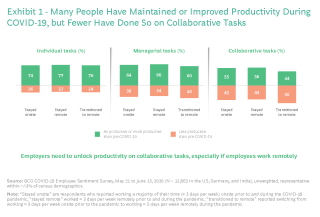
    To understand why, we dug more deeply into the data. And we focused our analysis on collaborative tasks because, as our survey reveals, in this new remote or hybrid world, collaborative work seems harder and appears to generate the most concern among employers—many of whom assume teams need to meet in person to collaborate. We found four factors that correlate with employee perceptions of their productivity on collaborative tasks, whether working remotely or onsite: social connectivity, mental health, physical health, and workplace tools.

    An impressive 79% of respondents who indicated they are satisfied or doing better on all four of these factors said they have been able to maintain or improve productivity on collaborative tasks. In contrast, employee dissatisfaction with a high number of these factors is cause for concern. When we looked at respondents who are dissatisfied or doing worse on at least three factors, only 16% (from a small sample size, with a confidence interval of +/- 3% at 80% confidence) said they have been able to maintain or improve productivity. That’s a difference of almost 400%!

    We now walk through each factor in turn.

    Social Connectivity. Most surprising in our analysis is the outsize impact that social connectivity has on productivity: employees who reported satisfaction with social connectivity with their colleagues are two to three times more likely to have maintained or improved their productivity on collaborative tasks than those who are dissatisfied with their connections. (See Exhibit 2.) Social connectivity, it turns out, is what enables us to be collaboratively productive. And collaborative productivity is essential for any company looking to improve communication, increase efficiency, accelerate skills acquisition, or harness innovation.
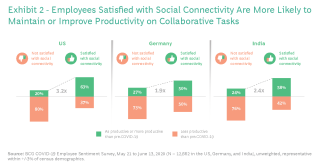
    Furthermore, our survey suggests that employees miss the connectivity they had with colleagues in the office. Respondents told us they miss “being able to spontaneously walk to a coworker’s desk and discuss an issue” and “social gatherings at work.” It will be critical for companies to recreate this connectivity regardless of where employees are located.

    Mental Health. Similarly, survey responses show a correlation between mental health and productivity: people who have experienced better mental health during the pandemic than before it are about two times more likely to maintain or improve their productivity on collaborative tasks than those who have experienced worse mental health. While awareness of the impact of mental health on work has been increasing, the pandemic—and the stresses and anxieties it has created—underscores how critical it is for employers to recognize the links between mental health and productivity.

    Physical Health. For a long time, physical health has been recognized as a driver of productivity, reducing absenteeism and creating a more focused, higher-performing workforce. Our findings provide compelling evidence of this: employees who have experienced better physical health during the pandemic than before it are about twice as likely to have maintained or improved their productivity on collaborative tasks as those with worse physical health. This highlights the importance of building time for sleep, exercise, and nutrition into the new work routines.

    Workplace Tools. When we asked respondents about their satisfaction with tools such as videoconferencing, virtual white boards, and project management software, we found another powerful driver of productivity: employees who are satisfied with their tools are about twice as likely to have maintained or improved their productivity on collaborative tasks as those not satisfied with their tools. One tech industry respondent said that “having a desk setup the same as the office and home with the same connectivity” is essential for him in maintaining productivity, while other respondents reported that digital applications and tools such as videoconferencing are important to maintaining their productivity levels.

    A NEW WORLD OF WORK

    Shifts in the way we work are likely to continue as employers move a growing portion of their employees to more flexible models. In fact, BCG’s recent Workplace of the Future employer survey found that companies expect about 40% of their employees to follow a remote-working model in the future.

    One financial services company told us it believes a hybrid model (rather than 100% remote) would likely be the working model of choice for many of its employees, who see 100% remote work as unsustainable. The company said that its employees worked an estimated 25% of their time remotely before the pandemic, and it believes that this figure could rise to approximately 50% or more.

    Employer expectations are in line with the seismic shift in the way employees are thinking about their workplace. In our research, 60% of employees said they want some flexibility in where and/or when they work. (See Exhibit 3.) This response was most pronounced in the US (67%), while the figure was 50% in India. Combined with our findings on what drives employee productivity, this underscores the fact that listening and responding to what employees want are essential to a company’s success, including its ability to attract and retain talent.

    It is encouraging, therefore, that managers appear receptive to flexible models. In our survey, we were struck to find that of respondents who are managers—and some might not expect all managers to welcome increased flexibility—most are in fact very open to this. Over 70% of managers said they are more open to flexible models for their teams than they were before the pandemic.

    WHAT THIS MEANS FOR EMPLOYERS

    Our findings suggest that the future of work will be increasingly hybrid. And this presents both challenges and opportunities: to reimagine the entire employee experience and to create conditions that allow employees to thrive in the workplace of the future—one that will be far less office centric. This means developing new hybrid working models that enable employees to move seamlessly between onsite and remote work, as well as thinking about the appropriate physical space—both size and shape—for the hybrid office.

    Our findings suggest that the future of work will be increasingly hybrid.

    Some challenges are more demanding than others. The good news is that companies have already been investing heavily in the tools needed to work remotely. In our Workplace of the Future survey, 87% of employers said they anticipate prioritizing tech and digital infrastructure investments that support sustained remote work.

    When it comes to promoting good employee health, companies need to focus on both physical health and mental well-being. While employees who are no longer commuting have more time to exercise, it is easy for them to be sedentary when working remotely. Meanwhile, with 29% of respondents telling us they have experienced worse overall mental health during COVID-19, it is imperative for employers to create awareness and develop tools and benefits that support employees’ needs. Many companies are experimenting with new approaches, as P&G Indian Subcontinent is doing by inviting employees to webinars with emotional well-being experts, according to a recent report from the Economic Times of India.

    Perhaps most challenging, but with the highest payback, will be figuring out how to maximize the social connectivity that takes place in the office. When employees are working remotely, it is hard to replicate the spontaneity of the “water cooler moment” or the camaraderie created by an impromptu lunch, a hallway conversation, or even a fire drill. But even those can be recreated with impromptu calls, whether by phone or FaceTime. And that’s important, not just for employees at home but for those onsite, where social-distancing practices and the fact that many colleagues are accessible only via video will hamper the kind of social connectivity that took place before the pandemic.

    It is too soon to provide all the answers. But employers should ask themselves a number of key questions as they work to design customized solutions. In the following sections, we present some of these questions, along with examples of solutions that could spark ideas.

    Social Connectivity. Recreating social connectivity in virtual and hybrid settings is tough but essential. And this will be even more critical as companies start to hire new employees who have not built social capital from pre-COVID-19 times.

    Some key questions to consider:

    • How do you foster a culture in which leaders see it as their responsibility to design and execute social-connectivity strategies and practices for their teams?
    • When employees work remotely, how do you replicate the ad hoc, serendipitous encounters with colleagues who work on the same team or were once down the hallway?
    • How do you build social capital with new employees who are fully remote?
    • How do you maintain team cohesion when some people are working remotely while others are onsite?
    • How do you create deep social connectivity in a distanced world where everyone wears a mask, which hides many telling facial expressions?

    Early Solutions. As they recognize the power of social connectivity at work, employers are thinking about how to replicate some of the more informal interactions that take place in physical workplaces. We see a number of companies coming up with creative ideas.

    Online services company GitLab encourages employees to set aside a few hours per week for virtual coffee breaks and to use Slack for informal connections and conversations. It has also created a “Random Room” on Google Hangouts where anyone can drop in, mimicking unplanned social interactions or water cooler moments.1

    As described in a recent post from one of our BCG leaders, the serendipity of impromptu hallway or cafeteria-style meetings can be recreated by randomly FaceTiming team members to ask how they are doing.

    Companies can also try to make virtual team activities fun. Clevertech, a software company, encourages its employees to play videogames that simulate a collaborative environment and enable complex problems to be solved by the group.2

    Mental Health. While companies are increasingly recognizing the importance of this issue, managing employee mental-health challenges—both recognizing problems and addressing them—has never been easy for companies. And when employees are working remotely, it adds to the challenges.

    Some key questions to consider:

    • What steps should you take to help employees manage the burdens of working remotely, such as the blurring of work-life boundaries and the cognitive overload from being digitally engaged all day?
    • What systems and benefits do you need to put in place in order to support employees who are experiencing mental-health difficulties?

    Early Solutions. Companies need to find ways of supporting employees’ mental health in the new remote and hybrid workplace. From free therapy sessions to educational efforts, companies are starting to develop solutions to this challenge.

    Companies need to find ways of supporting employees’ mental health in the new remote and hybrid workplace.

    Front, a workplace-communications platform provider, offers an employee assistance program in the form of a confidential counseling service to help employees with challenges related to work, family, stress, finances, and other personal issues.

    According to the Economic Times of India, Microsoft India is bringing in experts to educate leaders and employees on the importance of mental health and well-being during these challenging times.

    Employers can also make a therapist available for confidential appointments. In March, for example, Starbucks announced that it would provide all its US-based employees and eligible family members with 20 free therapy sessions a year, according to the Wall Street Journal.

    Physical Health. A productive workforce is a healthy workforce. This means promoting positive healthy behaviors in the remote and hybrid workplace.

    Some key questions to consider:

    • Without being able to provide access to a corporate gym, what other benefits, incentives, and structures might you put in place to encourage physical well-being?
    • How do you create team-level work-life balance?

    Early Solutions. To encourage employees’ physical health, employers need to create new structures that make it easy for employees to remain fit and well. These can either be offered as benefits or be built into the workday itself.

    BCG has created wellness challenges for employees and highlighted winners in the company newsletter. In addition, many BCG offices offer meditation sessions, online fitness classes, and health webinars.

    Employers can also consider scheduling regular meetings while out walking in order to build physical fitness into the workday.

    To create team-level work-life balance, one approach is to carve out work-free hours every evening or set limits on how early or late work calls can be scheduled.

    Workplace Tools. Given the ubiquity of digital technology in the traditional workplace, the virtual or hybrid version needs to replicate this. Employers must use these tools to make it easy for employees not only to carry out their daily tasks but also to collaborate with their teams and other members of the organization—wherever they are located.

    Key questions to consider:

    • What digital tools do employees need in a non-office-centric workplace—particularly to support collaborative tasks?
    • What role does the company play in either providing the physical tools and equipment needed to work from home, such as external monitors and ergonomic chairs, or compensating employees so that they can purchase them?
    • When part of the team is in the office and part of it is at home, how do you develop norms to ensure that everyone feels included?
    • For those working at home, how do you create the sense of a workplace?

    Early Solutions. Some companies were already investing in tools for the virtual workplace before the COVID-19 outbreak. But the pandemic has accelerated the rate at which employers are coming up with ways to ensure that employees have all the equipment they need to work efficiently, even when working remotely.

    Cisco got ahead of the game. Even before COVID-19, it routinely invested in setting up its TelePresence system—videoconferencing technology that makes two physically separate rooms resemble a single space—in the homes of its managers and leaders to ensure that they remain productive when working remotely and to facilitate virtual collaboration.

    Companies have reacted swiftly to the changes. Initiatives range from helping employees to create comfortable workstations by giving them allowances for the purchase of equipment to delivering technology and office equipment to their homes and subsidizing their broadband costs.

    When teams are split between home and office, remote members often feel at a disadvantage during meetings vis-à-vis those who are physically together. To counter this concern and promote equal participation in meetings, one option is to have all participants dial in to the call individually, even if they are onsite.

    For each new challenge that arises in the remote and hybrid work world, employers will need to determine the specific tools and techniques that fit into their corporate culture and work patterns.It will be important to understand employee productivity as the workplace continues to evolve. This evolution will increase the need for employers to measure employee productivity in conjunction with employee perceptions. But the key questions and examples featured here provide a starting point for consideration so that companies can enhance productivity whenever and wherever work is happening.

    WINNERS IN THE NEW REALITY

    Powerful forces are driving an increasingly productive workforce for whom traditional boundaries have been eroded and whose physical workplace is shifting beyond recognition. Investments in physical infrastructure, support (such as daycare), and digital technologies will of course be essential. But to benefit fully from the changes, organizations need to focus on helping leaders, managers, and employees to promote physical and mental well-being and—most important—virtual social connections. Given what our data reveals on this, all companies should be urgently investing in building their virtual social-intimacy muscles.

    They also need to make transitions between onsite and remote work as smooth as possible, giving employees a cohesive experience that feels designed, not random, and allows them to perform at their best whether onsite or working remotely.

    This crisis has presented a once-in-a-lifetime opportunity to reinvent the workplace. Things that might once have seemed impossible have proved surprisingly workable. With collaborative productivity essential to innovation, the changes will enable companies to become more competitive. And given employee desires for flexibility, the changes will also allow companies to recruit and retain the best talent.

    Moreover, focusing on well-being and social connectivity will serve another important purpose: helping employees to recover faster from what, for so many people, has been a traumatic, painful, and stressful period. And that is not only good for business—it is good for people.

    The authors are grateful to many people who contributed to the research, writing, and production of this report, including Gaby Barrios, Stefanie Beck, Gibson Farone-Collins, Beth Kaufman, Elizabeth Kuriakose, and Krista Ryu.

  • Sustaining productivity in a virtual world

    New world. New skills. by PwC

    Maintaining productivity levels among remote employees is an enduring challenge. Here are five ways to help people and businesses thrive in the post-pandemic world of work.

    by Nele Van BuggenhoutSoraya Murat, and Tom de Sousa

    Illustration by Lars Leetaru

    A version of this article appeared in the Winter 2020 issue of strategy+business.There is a gap between the digital skills people have and those needed to live, learn, and work in the digital world. The need to upskill — to bridge this gap — is a complex problem that will require government administrators, educators, and business leaders to come together. To learn more about upskilling your own workforce, go to Upskill my workforce for the digital world.

    How was lockdown for your teams? Are they feeling stressed and isolated? Or has working from home turned out to be a productive, commute-free, work-in-comfy-clothes revelation? One thing seems certain: This global, flexible-working experiment has changed our professional routines, probably for good. In PwC US’s Remote Work Survey, conducted in June, 39 percent of U.S. executives said most of their office employees were working remotely at least one day a week before the pandemic. But during the COVID-19 crisis, almost everyone who could work exclusively from home did so.

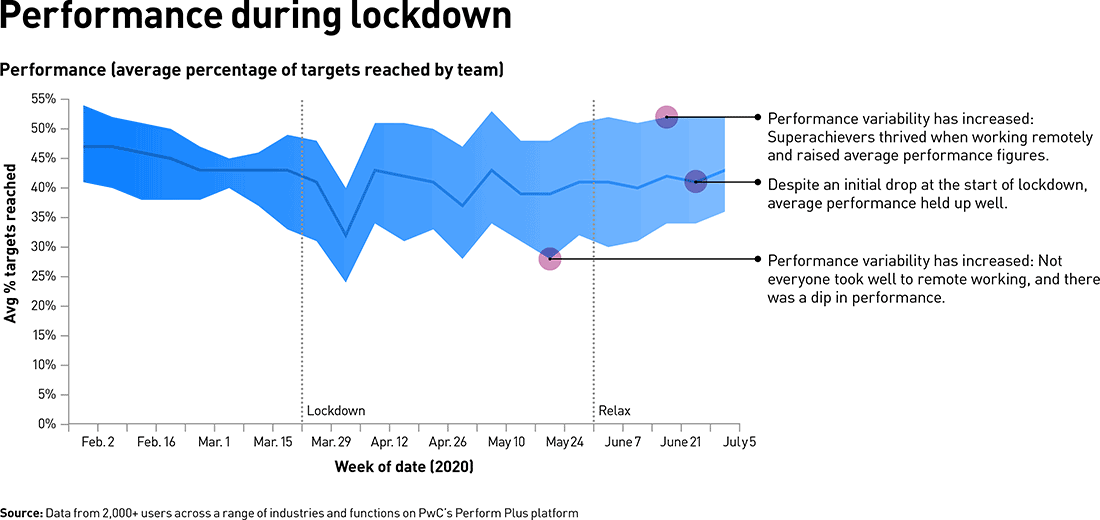
    Our research found that three-quarters of executives judged the forced experiment a success, contrary to the expectations of many. Data collected at the beginning of the lockdown and through the more recent opening-up phase of the pandemic shows that productivity, despite an initial drop, soon improved during lockdown and got back on track (see “Performance during lockdown”). This finding is backed up by our spring surveys of chief financial officers; in March, 63 percent of business leaders were concerned that remote working would result in lost productivity, but by June, this number had fallen to just 26 percent.

    Chart showing productivity of workers in 2020, week by week. Average performance is fairly steady, but it’s being sustained by superachievers.

    The bottom-line results show steady or increased productivity — that’s the solid line in the exhibit showing an uptick — which on first reading looks like good news, but those results hide a potential problem that appears when you look harder at the data. There is greater variation around mean performance in the weeks after lockdown than before: The blue bands start widening as lockdowns are enforced. This suggests that productivity has been propped up by a cohort of superachievers (around one-third of the total sample), which has disguised a fall in productivity among the rest.

    These superachievers have worked harder and longer than before in the exceptional circumstances of the pandemic — perhaps because they have benefited from fewer distractions, or have fed off the adrenaline of the crisis. The rest of the employees found things more difficult; remote working doesn’t suit everyone, for practical or emotional reasons or a combination of the two. This breeds stress and fatigue, which present risks to engagement, performance, and mental health. “I’m feeling Zoomed out” is a familiar lament. The challenge for leaders is to find ways to tackle performance, because they cannot rely on superachievers to keep making up the shortfall for much longer.

    Related stories

    This analysis comes from data collected from more than 2,000 users of Perform Plus, a tool developed by PwC that helps drive daily discussions on team and individual performance, which also includes an emphasis on well-being. The tool does this through the use of gamification and visual dashboards, and also records how people connect with one another and how they are feeling about their work through daily check-ins. This data is collected and analyzed to monitor trends, and the insights can trigger important dialogues with employees. Understanding what is going on in this way helps leaders develop strategies that fit the needs of their business and their people as they repair, rethink, and reconfigure their workforce to avoid potential pitfalls ahead.

    The key question about the productivity data is whether it is sustainable as people start returning to work in the coming months, when businesses will see more of their people working from home as part of a hybrid model when the COVID-19 crisis has largely passed. We don’t think it is, unless leaders take direct steps to address the differences in performance among employees. To do this, they will have to invest in the underlying systems and processes that will help teams work in a productive and engaged manner. Here are five key points for businesses and leaders to bear in mind when developing ways to make remote working a success and sustain performance and engagement.

    Define the right set of KPIs. Effective performance management of remote workers calls for holistic indicators; key performance indicators (KPIs) aren’t simply a matter of sales calls made or reports filed. Business KPIs that track both productivity (in terms of output) and effectiveness drive focus and accountability within the team, but well-being and collaboration KPIs should be added too. They can help predict productivity, or provide early warnings when people are feeling strained.

    More PwC insights

    These well-being and collaboration metrics could include measures such as the number of touch points between teams, or individuals’ mood levels, or how people are coping with their workload. Well-being and happiness, of course, mean different things to different people, so the data isn’t a definitive measure — but it can open up a discussion for people to explain and explore (if they wish) the reasons they’re not feeling great, and allow for the option of getting support.

    Create a connected team. Regular meetings help maintain a connected team and sense of community, even when people are working remotely. In fact, our data suggests that remote workers actively seek out opportunities to connect — we observed a rise in collaborative activity of more than 20 percent among Perform Plus users in the weeks following lockdown.

    Frequent touch points create opportunities to discuss performance, well-being, priorities, and any issues at hand, as well as to celebrate successes. In the Perform Plus tool, daily “huddles” of just 15 minutes allow participants to review the key metrics that matter most.

    The U.K. workforce of business software provider Sage, which includes around 1,000 customer-facing employees, switched to remote working in March. They had also been using Perform Plus for more than a year, and after the switch, the tool helped teams retain their “community way of working” during lockdown. “They may have been working from home, but there was still a tight connection within the team,” said Jon Cummins, VP of services and customer success at Sage, which is headquartered in Newcastle, England. The huddles that formed the core of the platform were held virtually. “This meant that ideas could still be shared, and people could ask their colleagues how they were dealing with specific situations. It meant that a sense of isolation didn’t develop and permeate the business,” Cummins said. The results were encouraging. According to Cummins, “Productivity increased for customer service teams over that time, [according to] the customer satisfaction measures we use, and we saw the mood of the vast majority of our people improve or remain at a strong level.”

    Develop the role of leaders. Leading a remote team requires a strong emphasis on specific leadership skills — such as empathy, the ability to foster a sense of community, and the employment of digital skills that maximize the use of technology — and this should be recognized in leadership training and development. Team leaders may need specific coaching in order to successfully manage underperformers; for example, it’s far more challenging to hold a difficult conversation remotely.

    The challenge for leaders is to find ways to tackle performance, because they cannot rely on superachievers to keep making up the shortfall for much longer.

    Some leadership skills in a remote environment are more esoteric, but no less important. Remote workers need to feel a sense of empowerment in order to give their best, for instance. Leaders will need to create an environment in which teams take ownership of their work and of their preferred working style when they are away from the office.

    Organizations will need to adapt their leadership development strategy in order to create leaders who can bring out the best among their remote teams. This development strategy should also recognize the different demands placed on leaders in this new environment; adding recovery time to schedules and monitoring the well-being of high performers will be essential in the months ahead.

    Build in positive recognition. Regular recognition not only helps maintain a positive working culture, but is also an important driver of productivity. Recognition becomes even more important in a remote environment in which managers don’t have access to the physical and verbal clues they might pick up on in the office, and there are now fewer “watercooler” opportunities to provide on-the-spot acknowledgment. Leaders should identify fresh occasions to express recognition, tailored to individuals in a meaningful and genuine way. Technology can help here through techniques such as gamification: Performance leader boards or competitions with prizes can encourage desired behaviors.

    Use structure to deflect distractions. Even before lockdown, our data suggested that as much as 30 percent of a team’s time was spent on non-value-adding activities. There is a risk this percentage could increase in a new hybrid work environment as a result of home distractions, child care, and the tendency of some to feel burned out after a long day of virtual conference calls. Building clear structure into team schedules — such as short daily catch-ups, focused time for specific activities, and breaks — helps support the focus of a dispersed team.

    Technology has given us the opportunity to collect data on well-being and collaboration, and to make a connection between those data points and productivity. But it can do so much more. The data indicates that not everyone found lockdown to be a productive or happy period. That’s actionable information that managers can use to help people adjust.

    The hybrid working model is likely to be the new reality, and people will have to adjust as new working habits emerge. The winners in this new virtual world will be those organizations that successfully navigate the specific challenges of managing remote teams. The variation in productivity levels during lockdown suggests that current performance levels are unsustainable because they rely on superachievers pulling up the average, but the five points outlined will help organizations and their leaders maintain and improve productivity and engagement levels for everyone as we move into this new world of work.

  • Turning Good Employees into Great Leaders – The Practical Way!

    By Liliana Chitnis 1/30/2021 3:00PM

    Employee development is a combined effort of both the employee and the employer. Great managers constantly aim to groom their employees for leadership roles. As they say, leaders aren’t born; they are made. Guidance and experience can transform an average employee into a great leader. 

    Leadership development is thus composed of a series of events and activities related to a particular profession, creating or developing sets of skills, attitudes, and knowledge in people’s performance. The strategies listed below are vital to start developing the skills that will benefit you and your employees.

    · Being a mentor to them: Being a mentor is the most functional and practical tool for sustained growth and hone leadership skills. A mentor-mentee relationship also allows employees to discuss their goals, expectations, and challenges while developing leadership skills. 

    Cross-training is essential to boost employee and team performance that also prepares employees for expanded roles within the company.

    · Providing them growth opportunities: Growth opportunities can include endless options like paying for formal education, internal or external training, bringing in industry professionals for a lunch-and-learn program. 

    · Encouraging them to learn how to network: Networking can help turn good employees into great leaders by raising their reputation within the industry. Networking will teach them how to forge powerful connections, initiate conversations with strangers, and act with a leader’s confidence. 

    · Always give them feedback: A successful feedback loop measures and reviews employee performance to improve future productivity. Meeting quarterly and discussing individual goals and understanding can help employers identify development opportunities and tailor development plans around the individual. 

    · Encourage good communication and transparency: Great leaders can make others inspire and understand their goals, outcomes, and missions. Excellent communication can only be taught by example, and the skill is mastered over time. This adds value and efficiency to leadership and, ultimately, to your business at various levels. Transparency and accountability must be at the epicentre of your organizational culture.

    · Helping them with delegating work: Delegating work helps employees learn how to have a productive task-driven workday in their way. This further inspires them to work towards the common goals of the business with positive outcomes.

    · Encourage decision making: Involving your team in the decision-making process can benefit your entire organization and help employee growth. This improves the quality of decision making, along with expertise and skills. Employees will also be well prepared and more in sync with each other.

    · Always be approachable: Great leaders are those who inspire others and welcome their opinions, challenges, and criticism. They also invite employees to other acting roles. When leadership style thrives and deepens, so will your employees’ leadership as part of your team. Leaders will inspire a future generation and drive sustainable business growth. 

    Becoming a great leader takes dedication, compassion, dedication, good communication, and energy. All these qualities can be learned and practised with the right guidance and support. Empathy offers flexible, bespoke coaching and training to turn your managers into great leaders.

    Author Bio:

    Liliana Chitnis is a former HR professional who now works as a content marketing executive at Naman, an organization that offers end-to-end HR solutions to help companies build a strong human capital base. She strongly believes in the power of consistent training in the workplace. Liliana writes about various topics related to human resources and shares trends, techniques, and tips with her readers. She loves to read and practice yoga regularly, and occasionally binge on Netflix.

  • 8 Best Practices to Improve Agile Procurement: Preparing for Procurement Volatility

    By: Margaret Wood Mar 9, 2020

    Purchasing and Alignment

    Companies that utilize high-performing MRO (maintenance, repair, and operations) procurement functions consistently outclass their competition. Procurement programs for buildings involve buying all materials necessary to keep buildings running and in top condition, including such things as paint, air conditioners, filters, uniforms, cleaning supplies, etc.

    To determine whether your company can cope with procurement volatility, it is essential to ask yourself:

    • Do your maintenance, repair, and operation procurement practices follow best-in-class practices?
    • Are your buildings running smoothly, and are they in good condition?
    • Do your employees ONLY make purchases through your MRO procurement system, taking advantage of the negotiated discounts with vendors, or is the procurement system too difficult to navigate?

    If your response was “no” to any of these questions, then the chances are that you are not only missing current opportunities, but you will not be ready for the challenges of the next decade. The volatility of all types of scenarios is going to make it much harder to get the supplies you need for your buildings on time and within budget. Agility will become increasingly tricky as volatility rises.

    As the earth’s resources waver in the price—or worse, become depleted—the butterfly effect has a global impact. Resource consumption is showing no signs of slowing down, and environmental sustainability is already becoming the critical pressure point of the next decade.

    Increased volatility – Many factors affect volatility, including global affairs, tariffs, Brexit, recession, rising oil prices, pandemics, currency markets, climate change, natural disasters, etc. And it is unpredictable to what degree they will affect.

    A perfect example of how a global crisis impacts procurement volatility is evident in how COVID-19 is affecting supply and demand economics – factories and banks are shutting down. There are insufficient supplies of hazmat suits and NV95 masks. People can only withdraw limited funds from the banks, and so on.

    At the base of the best companies’ success is the inclusion of advanced management strategies within their procurement strategies. By managing your MRO procurement, your company can better cope with new challenges and opportunities the global economy produces. Your MRO procurement strategies should be poised to turn volatility and scarcity into competitive yields.

    Evaluate Your Risks

    The primary objective of any purchasing organization is the ability to “turn on a dime.” By asking yourself some basic questions and staying informed on the increasing volatility of the global market, you will be able to:

    • Evaluate the various risks in your supply chain
    • Assess which risks need to examined more thoroughly, which risks require tempering, and which risks are acceptable
    • Evaluate your current business-continuity plans for coping with the most precarious supply risks

    Agile Procurement; Purchasing and Alignment

    Three of the most critical aspects of procurement are negotiating the best prices under contractmanaging and tracking suppliers effectively, turning procurement volatility into a competitive advantage.

    Here we provide you 8 best practices to help you plan for procurement volatility, improve agile procurement, an effectively manage your MRO Procurement system:

    1. One of the ideal ways to prepare for procurement volatility is to study what leading organizations are doing to gain advantages.
    2. Negotiating contract prices with dedicated suppliers is an excellent practice to lock down pricing and volume purchasing
    3. By aligning your purchasing and becoming more deeply involved in global sourcing markets, you gain clarity on market trends and foresight into volatility.
    4. Agility and flexibility in procurement have quantifiable benefits. It takes both operational wisdom and strategy to become agile.
    5. Agility requires diligence –monitoring your vendors’ performance, and locating alternate suppliers in advance of a significant event can improve your company’s reaction time, gaining advantages over your competition in both cost and market share.
    6. Anticipate and prepare for change; locate dual sourcing for all critical components; this will help boost output from alternative suppliers, and provide multiple resources for products or materials.
    7. Know where your suppliers are located, including those you’ve only used occasionally – this becomes important when a location becomes an issue.
    8. Vet all suppliers, so you know who can rely on to accommodate your needs and who can call upon in the event your primary supplier cannot fulfill your needs.

    Cross-functionality

    Agile procurement anticipates uncertainty.

    How cross-functionality can help you in times of need

    • You can improve cross-functionality by including Operations and Building Maintenance in agility planning; this provides you the ability to review the material assumptions more accurately
    • Alter your product orders based on the price levels of materials.
    • When negotiating contracts, a flexible contract that allows for volume adjustments will help you manage costs more effectively.
    • By establishing market intelligence teams, you can gain insight into trends and availability and price changes

    All materials are property of LeadershipFlagship © 2020

  • Some of the worst advice given to Millennials

    Here is some of the worst advice currently being given to Millennials


    Here are the seven pieces of advice that I HATE hearing people give to Millennials. Top of the list: Work harder you lazy punk!

    What is the worst advice being given to Millennials?

    Here are the 7 pieces of advice that I HATE hearing people give Millennials.

    1. Work harder you lazy punk!

    Despite popular belief, most Millennials aren’t entitled, lazy, or stupid.

    In fact, to the contrary, they work way too hard.

    I know dozens of guys in their mid-20’s who are literally working away the best decade of their life because they want to be a #hustler and achieve financial freedom.

    While there’s nothing wrong with working hard, you shouldn’t sacrifice your quality of life for a big paycheck.

    Enjoy your 20’s. Work hard. But LIVE too.

    No …

    You don’t need to figure out what you want to do with your life yet.

    You have more options than your parents did and exponentially more options than your grandparents could have dreamed of, so they can shove it if they think they have the right to tell you to “Hurry it up and make up your mind already.”

    Embrace slowness.

    Try out dozens of different career paths and figure out what you like.

    Honestly, your 20’s are for throwing crap at the wall and seeing what you like.

    It’s not for figuring yourself out anymore.

    3. Go to college and get into debt for your “future”

    College is largely a waste of time.

    Unless you have your sights set on a career in finance, medicine, or law, you don’t need a degree and going into $50,000–$100,000 of debt for a Liberal Arts degree is the dumbest thing you can do.

    Go find a job working for a company that you like.

    If you can’t find a job, then go MAKE one.

    Show up and just start doing stuff, ask if you can help out without getting paid. Eventually, someone will offer you something.

    Don’t be afraid to eat sh-t for a few years so that you can eat like a king for the rest of your life. College is a waste of time, but education isn’t.

    4. Your 30s are your new 20s

    No … They’re not.

    Even though I don’t think you should have your entire life figured out in your 20s, you need to be building a strong foundation for your future.

    It’s ok to party a little and goof around, but you need to take your time and your life SERIOUSLY.

    DO NOT waste your 20s playing video games and drinking yourself into oblivion.

    That’s a one-way ticket to a life of regret.

    Work hard, build good habits, educate yourself massively, just don’t put too much pressure on yourself to actually achieve ‘success’ or ‘find yourself’ yet. If you play your 20s right then you will get those rewards in your early 30s.

    5. You guys should just get married already!

    Let’s see …

    The divorce rates are skyrocketing, more people than ever report being unhappy in their marriages, divorce will cost you half of your net worth (if you’re a man), and will probably leave you with trust issues and all sorts of other problems.

    … But yeah, let’s encourage naive 20-somethings who have never been in a REAL relationship to jump the gun and just get married.

    That sounds like a GREAT idea.

    In case you couldn’t hear the sarcasm dripping from my voice, I do NOT encourage Millennials to get married young.

    I know that everyone is putting pressure on you to get hitched and you think it will be the best idea ever … But just delay gratification and give your brain (and bank account and personality) a chance to mature before you make a life-altering decision like marriage.

    Ok?

    6. The job market is competitive!

    Sure, the job market is competitive. For people who want to work for sh!##* corporations and established “Old Money” businesses.

    But if you want to get involved with the new rich? It’s easier today than ever before.

    My Director of Content started working with me when he was 17. He didn’t have a college degree (or even a high school degree). But he was a good writer, and he just kept pestering me until I eventually got on the phone with him, and he pitched his services for free.

    The fishing is best where the fewest go.

    So stop trying to get a job in the competitive markets and instead be willing to eat crap for a few months or years proving yourself at a startup or small business.

    You’ll quickly become indispensable and earn whatever you want.

    7. You can sleep when you’re dead

    SHUT UP!

    Sleep deprivation is literally killing our society and costs the economy more than $400 billion in lost productivity each year.

    Quit glorifying sleep deprivation and espousing ignorant ideas.

    Sleep is freaking important so stop vilifying Millennials for prioritizing sleep.

    If you aren’t getting 8 hours a night, you are leaving productivity and performance on the table.

    Ignore your grandparents and get your zzzz’s.

    You’ll be glad that you did.