• How Toxic Cultures Impact Your Health & Wellbeing

    Get Ahead of a Toxic Culture

    Did you know that dishonesty may actually breed more dishonesty for a neurological reason?

  • Lead, Connect And Engage With Millennials: How to create the perfect work environment
    Ascanio PignatelliExcerpts of an article posted on 07-08-2016, by:Ascanio Pignatelli
     

    “Anything is possible in the right environment.” 

    Several experts I recently interviewed for a book I’m writing on “Engaging Millennials” seem to agree. I asked them, “Why are companies struggling to engage millennials and what do you suggest?” I’ve successfully applied this principle everywhere in my life and find it as the key to connecting and engaging with others, especially millennials.   [The] interviews clearly show there are four things millennials need if they are to be engaged at work:

    Growth 

    If your millennials feel they are not making progress in their own personal development they will soon become disconnected and seek opportunities elsewhere.

    “Millennials are rejecting traditional rules about career development and work culture,” explains Ketti Salemme, Senior Communication Manager at TINYpulse. “Rather than wait years for a promotion, millennials are looking for fast growth.”

    Joe Redmond concurs. “They want to be promoted at an accelerated rate (not satisfied with the traditional three to five years approach).” He suggests that managers should get their millennials involved in projects that foster experiential learning and development. Besides creating the engagement and development needed to retain your existing millennials, you’ll also be attracting new ones!

    Connection

    By now, most of us are well aware that companies with workplaces that foster strong friendships among their employees have far higher engagement rates than those that don’t. This is especially true of millennials who are hyper-connected to begin with. Here are five tips to better connect with them:

    Give them more face time at work. Regular meetings and continuous feedback boost engagement and performance. Besides, millennials crave constant interaction and won’t settle for a laissez-faire boss who only meets with them occasionally. Schedule weekly meetings with your millennials and get their feedback as well. Ask them “How can I be a better manager?” Then be sincere and take their advice.

    Engage them outside of work. Alim Erginoglu, an employee engagement consultant at Towers Watson makes a great point: “Successful companies connect with their millennials not only during working hours but outside of work as well. Millennials see work not an only a place you go in and earn money to live, but to socialize, innovate, learn and enjoy. In a way, they amalgamate their life with work and as long as they can do that they feel engaged. Work does not limit their life but is a part of it.”

    Keep it real. Another way to connect with your millennials, is by creating greater trust- and that starts by being more authentic and transparent. Great leaders don’t stress about how they might be perceived and neither should you. Forget about who you think you should be, and just be yourself. As Karl Moore, in a recent Forbes article points out: “The better you are at being an authentic leader, the more your millennial employees will appreciate you.”
    Be vulnerable. If authenticity gains the trust, respect, and appreciation of your millennials, vulnerability amplifies it. Millennials are the most educated generation ever, and they know we all have the same fears of not being good enough, smart enough or worthy enough.
    Dare to care. The best managers connect deeply with their millennial employees by paying attention to what’s important to them. Nicole Cunningham, Sr. Manager of Employee Experience at Knot Standard, and a millennial herself feels that managers are struggling to engage millennials because, “They are failing to focus on what motivates the individual. Although millennials enjoy working in groups and working collectively with the team, they are individually motivated.” Become a master listener and get to the root of what matters.

    “Find out what makes Millennials tick and then capitalize on it,” says Jonathon Villaire, an Employee Engagement Leader at AIG. Carve out some time each week to grab lunch or a coffee with each of your direct reports. Ask them what they enjoy doing outside of work and get to know them personally. As you build a meaningful relationship with them, they will give more of themselves.

    Purpose 
    Doing meaningful work gives our lives purpose and studies show that millennials are happiest and most engaged at work when they feel they are making a difference. There is a clear disconnect between companies and their millennials, so here’s what you can do:
    Bridge the gap. Employee engagement expert Lisa Morris at North Highland points out: “I believe the challenge comes down to employees wanting a work experience that is valuable and meaningful to them as individuals. Organizations on the other hand are focused on efficiency and effectiveness.” So keep looking for ways to make their work feel more meaningful- better yet, ask them!

    Focus on their strengths. A recent study by Gallup found that millennials, more than any other generation, are asking, “Does this organization value my strengths and my contribution?” People are happiest and most productive when they are doing what they do best. Find out what each of your millennials excels at, then figure out how they can do more of whatever they’re naturally great at.

    Align what they’re doing with what’s important to them. Once you know their values its easy to connect what they care about with what they’re doing. Earlier this year, while on a coaching call with a senior Fortune 1000 executive, she confided that she was feeling super disengaged; she was dreading having to spend the next day or so ensuring that a very important spreadsheet was error free. Knowing she cared for her coworkers I simply asked her, “How will your team benefit once you’ve meticulous scrutinized this spreadsheet?” As soon as she realized how her work would impact her team, her energy skyrocketed and she felt more engaged.

    Acknowledge their impact. Make sure you publicly acknowledge the contribution your young reports are having on the organization. “Millennials expect to be recognized much more frequently than members of previous generations,” says Mark Fulford an MBA professor at the University of Central Missouri. Recognizing, praising and celebrating their successes whenever possible will pay huge dividends in the long run.

    Coaching
    If managers are to succeed at engaging their millennials their leadership style needs to become more coach-centric. The authoritative, command-and-control style of management might have worked with traditionalists, but won’t stand a chance with millennials.

    “They view authority differently,” explains Joe Redmond, a director of employee engagement at Olympus Surgical Technologies. “They tend not to want managers. So have them participate in cross functional teams.” Millennials work great together and getting them to collaborate with each other is a huge step towards getting them engaged.

    Engagement also means empowerment, something that is imperative with millennials. Disempowered employees are also disengaged employees and will cost you and the organization more than an occasional headache. Become a great coach and empower your millennials by helping them become more confident, asking for their input on important issues and supporting them whenever possible.

    Conclusion
    Successfully engaging your millennials is a lot like engaging those Caribbean reef sharks; you’ll need to create the perfect work environment. Dianne Crampton, founder of TIGERS Success Series sums it up best: “The best managers are actively interested in their employees, learn about their needs and wants, and give their millennials immediate in-time feedback and coaching.”

    Here’s the bullet list you can take away to better lead, connect and engage your millennials:
    • Make sure they have a lot of opportunity to grow as leaders
    • Connect with them in and out of the office
    • Create more opportunities for them to collaborate with their coworkers 
    • Their work is important and makes a difference
    • Recognize and celebrate their work as often as possible
    • And finally, coach, empower and support them whenever you can.

    Ultimately, I think QK Toralba, Employee Engagement Manager at Acquire BPO and himself a millennial sums it up best: “Letting employees feel that they are valued, recognized and that there is an opportunity for growth are the biggest factors in having an engaged workforce.”

  • Employee Disengagement: Why the C-Suite Should Take it Seriously
    Harry WestPosted by: Harry West on 06-08-2016

    When a company is established, it usually starts with just a handful of employees. This core group is comprised of individuals who are passionate about the mission of the business; they’ll gladly work day and night to build a successful company. However, as a company grows, it becomes harder and harder to hire employees who are just as engaged and invested in the growth of a business, which is why we hear so much about the pains of companies growing at an accelerated rate.

    Business leaders can choose to tackle the resulting challenges in a timely and efficient manner or if they don’t, they effectively choose to pass off the creation of valuable work experiences and talent management to Human Resources. Those who choose the latter put the future growth of the company at risk by neglecting to accept the responsibility they have towards a key stakeholder group – their workforce.

    When the needs of the workforce aren’t being met, it isn’t always obvious from reviewing traditional metrics like employee turnover. A disengaged workforce can disintegrate a company’s culture, decrease customer satisfaction, and cost the business a lot of money.

    Building a Strong Company Culture

    When a workforce is disengaged, it breeds a dysfunctional culture that can result in the poisoning of an otherwise successful business.

    Netflix is a very famous example of a company that has been able to grow at a very rapid rate due to its successful, results-driven culture. In fact, the Netflix culture story is so popular that its 124 page “Netflix Culture: Freedom and Responsibility” document has been viewed on SlideShare more than 14 million times. What makes it unique is the high level of employee engagement exhibited by its high performing workforce; the result of true enterprise-wide transparency and honesty that is supported and promoted by all employees and people managers.

    The mistake most companies make is giving too much responsibility for the hiring and retention of employees to Human Resource departments.

    Leading companies like Netflix recognize the importance of employee engagement early on, promoting, and hiring employees who demonstrate the company’s values and deliver high performance. Perhaps most importantly, these innovative companies create a work environment where actions speak louder than words, and employees always know where they stand, what is expected of them, and how they contribute to the overall good of the company.

    Improving the Virtuous Cycle of Worker and Customer Experiences

    Historically, companies that survive and beat competitors are the ones able to change with the times and keep providing exceptional customer experiences. Businesses that struggle to change overlook the importance of the virtuous cycle of worker experiences that directly impact customer interactions in negative or positive ways.

    Today, change starts with having the right technology in place. When workers aren’t given access to the tools, information, and collaborative processes they need, they become disengaged and are unable to communicate effectively with customers. And customers don’t show loyalty to companies that offer a bad, or even average, customer experience.

    According to recent Gallup research, employee engagement in the U.S. remained relatively stagnant between 2012 and early 2016. Only in recent months has employee engagement started to see a slight uptick — a phenomenon that can be attributed to the rising demands of workers accustomed to the always-on, digital environment of today.

    Yet, the percentage of workers whom Gallup considers “engaged” in their job is still below 35 percent. The data clearly shows that the enterprise has a long way to go to ensure that most employees are “involved in, enthusiastic about, and committed to their work.”

    Increasing Profits

    Dissatisfied customers have a big impact on a business’s bottom line, which brings us to the most important reason worker engagement should be top of mind for executives. A workforce is the face of any company; workers’ behavior and actions determine the way daily conversations with customers will go. A highly engaged and productive employee or contractor can turn a dissatisfied customer into a loyal customer. Alternately, a highly disengaged employee can turn a returning customer away for good. One allows a company to reach or exceed business goals, while the other serves as a barrier to successfully achieving these goals.

    Outside of the delivery of exceptional customer service, a good worker experience empowers employees to be creative at their job — proactively bringing new ideas to the table and improving work methods and processes. An engaged workforce can be the true engine that drives operational efficiency and business growth. R&E


    Visit www.appirio.com
    Connect Harry West
    Follow @hj_west
  • HOW TO RESPOND WHEN AN EMPLOYEE MAKES A MAJOR MISTAKE
    chrisratigan


    by Chris Rhatigan on Oct 12, 2016 8:00:00 AM

    Strong leaders have a bright line on what they will and won’t tolerate. But what about when an otherwise hard-working employee makes a big-time error? We’re not talking about showing up to a meeting five minutes late; we’re talking about something that results in losing a client or pitching a project that fails.

    Good leaders allow their employees to make mistakes. After all, making errors is inherent if you want to create an environment that values innovation. Making errors is human, and even your best employees will make one at some point.

    However, simply allowing mistakes isn’t a management strategy. When an employee makes a major mistake, it’s time to ease their fears and look for ways to get the most out of them going forward. Here are five questions you should ask yourself when an employee makes one of those errors:

    01. How did the mistake happen?

    Asking the employee how the mistake happened is a good first step. It shows that you’re paying attention to their work and that you expect them to do their job well. This shouldn’t turn into a blame game, but instead be part of a learning process.

    Getting to the bottom of the problem is important. Was the error a momentary lapse for a usually careful worker? Or was it the result of a larger systemic problem? Investigating the issue thoroughly is a must.

    02. How is the employee responding?

    Good employees will reflect on how the error happened and take steps to correct it in the future. Managers can help the employee through this process.

    An employee who owns the mistake and learns from it is the kind of person you want on your team. If an employee isn’t taking the matter seriously, then you need to have a conversation with them.

    03. Is the mistake part of a larger problem?

    It’s one thing if the mistake is the result of a temporary lapse of judgment. It’s quite another if the error demonstrates a bigger problem.

    When a major mistake happens, this is a good time to evaluate your systems. Is there a gap in training? Are the lines of communication open? Often mistakes aren’t isolated to just one employee.

    04. Is the mistake part of a pattern?

    One mess up every so often is to be expected. But if the employee makes chronic errors — even small ones — these add up over time. Employees who are routinely careless or can’t be bothered to do things right need to be corrected. By allowing consistent mistakes without any response, you communicate to that’s acceptable to do sub-par work.

    05. Do employees feel comfortable taking risks?

    The flip side of this is that employees need to know that it’s OK to try something new. It’s a difficult balance to strike, but a necessary one for successful businesses.

    When your team takes risks, it means that they’re not accepting the status quo. This is mission critical for companies that want to compete in today’s challenging business environment. Sloppy work is one thing, but taking a risk that could have long-term dividends is another. It’s important to separate these two kinds of mistake.

    One thing is guaranteed: your employees (and you!) will make mistakes. Those mistakes will, at times, impact your bottom line. It’s how you respond to those mistakes that counts.


  • Delivering Benefit Bad News

    Excerpts from “How to Deliver Benefits Bad News” by Tim Sackett

    One of the biggest occupational hazards for someone on the benefits sides of HR is having to be the bearer of bad news. Benefits are expensive. Employers need to profit. Something has to give.

    More often than not, that something is benefits. Despite your best efforts to tweak plan designs, at the end of the day, you are the one who has to tell your coworkers that their copays are increasing, their deductibles are getting higher, or that their overall benefits package is shrinking. Delivering a not-so-great benefits message is a delicate art, but it’s something you have to become comfortable with if you plan on thriving in this line of work.

    Consider the Audience

    There are all kinds of benefits bad news, and all kinds of folks to whom you have to tell it. Before you begin crafting your communication plan, you need to understand how the bad news will affect your people.

    Who will feel the impact most? Is this something that will affect everybody companywide, like when there’s a senior management directive to cut HR costs? Or is it something that touches a much smaller group, like when there’s a new piece of legislation that changes the way a transit flexible spending account works?

    And what if the “bad news” is actually something good for most people? A new employer contribution to a highly promoted HSA plan that Medicare Part A enrollees can’t take advantage of, for instance. You may have an obligation to announce bad news to everybody, but if you want to be truly helpful, you’ll have to know who’s really affected the most so you can craft a follow-up plan.

    Make a Follow Up Plan

    Too many benefits departments go radio silent after bad news is announced. That’s a mistake. If you want to be smart about communicating negative changes to benefits, you’ll take the time to plan general follow-up communications for the entire audience as well as individual follow-ups for the employees who’ll be affected most.

    Sample Construction Plan

    180 Days Prior to Open Enrollment

     This is a high-level view from 50,000 feet. You’ll provide basic communication (email works well here) on the expected benefit design changes, anticipated additions or subtractions to the plans, as well as what’s working well, what’s not. This is a good opportunity to ask for employee input on what they like and dislike about the plan design, new/old benefits, and wish list stuff.

    Don’t Forget About Your Team

    Way too many organizations spend all their time and resources getting a communication right only to see their efforts fall flat because they haven’t taken the time to make sure the people actually delivering the message were capable and receptive to actually delivering it in the way it was designed.

    Not that your team aren’t professionals. They are. But they’re also employees who’ll be affected by the bad news too. If you don’t let them grieve the loss of whatever it is they’ll be losing, you risk having their unexpressed frustrations and resentments souring the message they’ve worked so hard to prepare.

    Give your team time to be upset, and also let them know that they don’t have to like the changes that have to take place. Let your team know that they can be honest about their personal feelings if the topic comes up in the course  of explaining the changes.

    If possible, model this tone for them in the way you discuss the changes with them.  Transparency, when controlled, is healthy for employees to see and understand. Besides, you don’t want to put anybody in a position where they’d have to be untruthful.

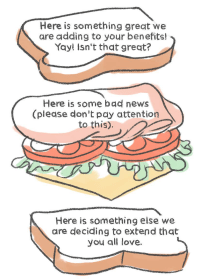
    bad-news-sandwich
    The Bad News Sandwich

    Avoid Surprises

    Avoid the tempation to give employees a “Bad News Sandwich”. Everyone hates this kind of communication. You hate delivering it and your employees hate receiving it.

    The worst communications you will ever deliver are the ones that surprise people.  Simply put: Negative surprises kill culture. Just as a good manager should never deliver negative surprises during a performance review, a good benefits professional should never deliver negative surprises during open enrollment.

    Great performance feedback happens in real time and on a continuous basis. Great benefits communications are similar. If you know you will have deep, or unpopular, cuts to your benefits, you need to start communicating those possibilities right away.

    Don’t wait to deliver bad news. Rip the Band-Aid off right away with a simple, forthcoming message that addresses business realities calmly, and uses language you’d use yourself if talking to your colleagues face to face

    120 Days Prior to Open Enrollment

    “We’ve gotten some preliminary analysis done our 2016 OE, and you should expect some increases to premiums in the 8-12% range. We are looking at a number of things including: (your list of things), and our hope is we can bring this amount down while maintaining a solid benefits package you’ve come to expect.”

    90 Days Prior to Open Enrollment

    You should be using more direct language when describing cost and plan design changes. Also, you’ll need to provide more direction to those who will be affected the most. This helps calm employee stress, and gets you out in front of possible turnover issues.

    60 Days Prior to Open Enrollment

    You now have the official dates and times for open enrollment on the books. You should have a solid understanding of benefit designs and costs. This is the time to begin selling the reasons of why changes need to be made.

    30 Days Prior to Open Enrollment

    Your communication take on a more administrative tone because all the good/bad news has been delivered many times. Focus on how employees can sign up and get the most use out of their new benefits. Any new benefits should be highlighted.

    Open  Enrollment

    The task of open enrollment should not be emotional because you’ve already presented all the good/bad news. It’s just a matter of paperwork from here.