• What is Substance Abuse Costing Your Company?
    Wednesday, June 7, 201

    A Cry for Help

    (An Excerpt)  Read Full Report Here

    …[I]n a study published at the end of last year, the Surgeon General, reported that more than 27 million people in the U.S. reported current use of illicit drugs or misuse of prescription drugs in 2015, and over 66 million people (nearly a quarter of the adult and adolescent population) reported binge drinking in the past month. (more…)

  • Why Overworking Doesn’t Work
    By Marian N. Ruderman, Cathleen Clerkin and Jennifer J. Deal, Talent Economy Influencers
  • 100 USEFUL PHRASES FOR PERFORMANCE REVIEWS

    100 USEFUL PHRASES FOR PERFORMANCE REVIEWS

    by Sabrina Son on Feb 10, 2016 8:00:00 AM
     Unless you’re actually a robot, it’s easy to say the wrong thing at the wrong time. Especially when it comes to a tender matter like performance reviews. And there are many resources out there that list forbidden performance review topics like personalities, rumors, or speculations. That’s great and all, but now you’re self-conscious about what you can say.

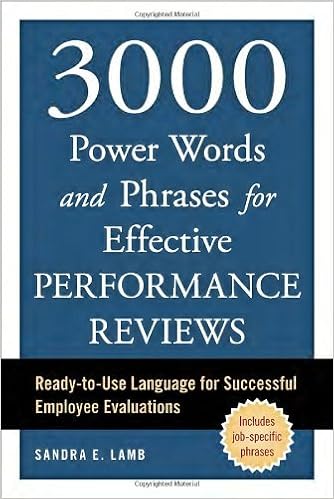
    So here’s a helpful list of 100 phrases — based off the book Effective Phrases For Performance Appraisals — that you should start including in your performance reviews. Keep in mind that these are starter phrases and you should be specific when you’re writing any feedback for reviews.

    100_Useful_Phrases_for_Performance_Reviews_1

     Achievement

    1. Achieves optimal levels of performance and accomplishment with / for …

    2. Provides strong evidence of [specific accomplishment]

    3. Excels at developing programs / strategies that have delivered X results

    4. Improved production by X% through [specific task]

    5. Exceeded the original goal of X by X% through [specific task]


    Administration

    6. Continuously examines administrative effectiveness and seeks better procedures such as [tasks]

    7. Develops successful administrative strategies such as [task] that led to [results]

    8. Establishes effective systems for information retrieval through [task]

    9. Improves administrative support systems through [task]

    10. Keeps documents organized via [task] to avoid duplicate information


    Coaching

    11. Shows a sincere interest in employees and the solutions to their problems

    12. Lends support and guidance to employees by [task]

    13. Uses sound coaching techniques to solve disciplinary problems

    14. Provides continuous coaching

    15. Is highly respected by employees for sharing concerns, problems, and opportunities


    Communication Skills

    16. Effectively communicates expectations

    17. Excels in facilitating group discussions

    18. Keeps meetings action oriented by [task]

    19. Effectively communicates upward, downward, and laterally

    20. Enforces company policies and values without creating negative reactions


    Cooperation

    21. Encourages collaboration with the team

    22. Shares ideas and techniques

    23. Builds strong relationships with others by [task]

    24. Displays a harmonious and cooperative spirit by [task]

    25. Gladly shares expertise


    Creativity

    26. Seeks creative alternatives such as [examples] that drove [results]

    27. Clever and imaginative when confronted with obstacles

    28. Is continuously experimenting to drive [results]

    29. Initiates and executes creative ideas such as [example]

    30. Seeks new ideas and approaches


    Delegating

    31. Empowers employees with the authority and resources to achieve X results

    32. Helps employees gain visibility through [task]

    33. Encourages employees to solve their own problems

    34. Delegates to match personal strengths

    35. Delegates with clearly defined responsibility and authority


    Improvement

    36. Develops continuous improvement methods

    37. Develops totally new strategies

    38. Continues to grow and improve

    39. Devises improved means of accomplishing results

    40. Is continuously planning for improvement


    Innovation

    41. Develops innovative strategies such as [example] …

    42. Is very innovative under adverse conditions

    43. Seeks innovative solutions

    44. Fosters a curiosity for innovative possibilities

    45. Promotes innovation by [example]


    Interpersonal Skills

    46. Recognizes the needs of others and reaches out to lend a helping hand

    47. Establishes effective working relationships

    48. Generates synergy

    49. Builds on mutual dependence and understanding

    50. Promotes the company culture among peers


    Learning Ability

    51. Displays an ability to learn rapidly and adapt quickly to changing situations

    52. Shares learning experience with peers

    53. Promotes a learning culture

    54. Committed to continuously learning through [example]

    55. Responds quickly to new instructions, situations, methods, and procedures


    Management Ability

    56. Provides team with support through [example]

    57. Collaborates with individual team members to establish a development path

    58. Holds employees accountable for their own results

    59. Provides team with the resources needed to attain restults

    60. Provides support during periods of organizational change


    Planning

    61. Develops workable action plans

    62. Creates flexible plans to meet changing opportunities

    63. Effectively puts plans into action

    64. Excels in developing strategic alternatives

    65. Effectively formulates strategies, tactics, and action plans to drive X results


    Potential

    66. Is capable of distinguished performance in a higher-level position

    67. Has reached the level for promotional consideration

    68. Is capable of handling bigger projects and assignments

    69. Is making a strong effort to acquire greater experience and skills to increase potential for advancement

    70. Is enhancing growth potential through additional education and training


    Problem Solving

    71. Displays a practical approach to solving problems

    72. Develops creative solutions

    73. Turns problems into opportunities

    74. Effectively solves problems rather than symptoms

    75. Is skilled in proposing optional solutions


    Productivity

    76. Exceeds normal output standards

    77. Continuously produces more than expected

    78. Is an important contributor to the successes of the department

    79. Makes a substantial contribution to the continued operation and growth of the organization

    80. Consistently exceeds performance goals


    Project Management

    81. Completed X project with X results

    82. Sets realistic timetables to keep projects on target

    83. Is transparent with a project’s progress

    84. Makes effective use of all available resources when given a project

    85. Clearly establishes project goals and objectives


    Supervisory Skills

    86. Gives consistent recognition to employees

    87. Maintains a work situation which stimulates the growth of individual employees

    88. Makes certain that employees have a clear understanding of their responsibilities

    89. Is readily available for support to employees

    90. Recognizes and deals with signs of employee burnout


    Time Management

    91. Consistently meets all deadlines

    92. Prepares meeting agendas that are concise and time saving

    93. Keeps meetings on schedule

    94. Respects the time of others

    95. Makes effective use of discretionary time


    Vision

    96. Excels in living the organiational values

    97. Promotes strong support of company’s mission and vision

    98. Is able to turn visions into actual action plans

    99. Demonstrates an ability to transfer vision into execution

    100. Excels in contributing to the company’s goals


    Again, these phrases mean nothing unless you attach specific examples and data to them. To ensure a performance review is truly effective, remember to evaluate on data rather than assumption.
  • Positive Psychology-Positive Leadership

    omqi3%2fraw_profile_logo_

    By Margaret Wood-HR Director

    There’s Positive Leadership in All of Us

    What is Positive Psychology and Positive Leadership?

    Definition:  using positive impetus and methodolgies to achieve the most desireable results in a given negative or toxic situation.

    Why is understanding Positive Psychology and Positive Leadership important?  
    Gone are the days of firing people on the spot. In many situations, there are laws protecting employees from these types of actions. Moreover, consider how much money your company has invested in training and grooming those employees.
    Globally, it is becoming more widely accepted to cultivate employees, utilize their skill sets, and empower them to achieve personal and corporate goals through better management and positive leadership. The results and benefits of this approach are far greater than the alternative.

    “What? Why?”

    Getting blindsided by losing a top-performer may stymie you. Your initial reaction may be, “Where is this coming from?  I thought everything was going well.” But once you stop and thing about it, was it going as well as you initially thought…

    “I’ll never reach these goals-they are so unreasonable?“

    “First they say focus on this, and now they say focus on that.  I wish they would get their act together!“” Everyone’s so negative lately. Why bother–they’ll just ignore me …  “

    “I have no idea how I’m doing-no sense in going out of my way for anything–it’s  not like anyone notices.“

    The reality is that most employees rarely tell their boss the whole truth about how they feel at work, fearful of repercussions and awkward conversations. Some feel it is easier to quit and start over-they don’t know how to ask for help.

    Although these are common thoughts amongst low-morale employees, this is where positive psychology and positive leadership can help turn things around. Before you attack the problem head-on,  and jump into fixing the situation,  stand back and analyze each component, and ask some questions. This will help you identify what needs to be done. It’s no different than when you decide to take off for places unknown-the first thing you do is Google a map. The same holds true here.

    As this is uncharted territory for you, ask yourself:

    • What could be triggering these attitudes?
      • Let’s consider your most exemplary employee: always on time, great attitude, first one to volunteer for new projects, always follows protocol, every little detail in its place, etc.
    • What/when/where did things  go wrong causing them to quit?
      • Unfortunately, the exit interview is where some of these questions are answered. But, why wait for this to happen?

    The first answer is that it was not one event, but rather a culmination of several factors that drove them to that decision. Interestingly enough though, this scenario has a tendency to play out more often within some companies, and rarely at others.

    • So, why the differences?
    • What is driving employees to quit at some companies and not others?
    • Are you doing something to cause this? If so, what is it?

    Perhaps the better question to ask yourself would be: What are we NOT doing that those other companies with better retention ARE doing?

    Another fact to be considered is that, as managers we make innocent assumptions that leave our teams confused and unfocused. What is obvious and evident to us may be nothing more than dense fog to them.  Here is where positive psychology and positive leadership come in! Take the time to explain all the pain points so that everyone is on the same page. Assume nothing – you are best served with providing too much information than not enough.

    Who is most accountable for employee morale – you (the manager) or the company?

    The Challenges Today’s Manager’s Face

    Being a manager in today’s world, regardless of the industry, is a challenge. Never before has the leadership community had to manage as many as 5 different generations at one time.  Since there is no longer a mandatory retirement age, and for the first time in history, managers find themselves leading teams of mixed generations that include  “traditionalists”, baby-boomers, Gen X, Y & Z and soon the iGens. Not an easy task!

    Taking into acount the vast differences in this diversity, it’s no wonder it has become so easy for team members to become disengaged, disenfranchised, demoralized and unproductive-it is a challenge to meet the requirements of so many different generations. However, there is no excuse for all team members not to be onboard with a company’s mission.Underperformers not only drain the morale out of the team, they are the biggest negative impact to your bottom line. One of the biggest mistakes leaders can make that only exacerbates this toxic situation is to avoid dealing with it, hoping it will eventually resolve itself.

    What is the best resolution for such a situation?

    One of the best resolutions is to make sweeping changes to the culture through positive psychology; additionally, you can either remove the instigators (Path of Least Resistance)  or remediate them through positive leadership. The key to connecting with your employees is communication, therefore gaining buy-in to these changes.

    Positive Psychology – Praise, Recognition, and Rewards

    Employee engagement takes an entire range of factors into consideration, from adequate tools to do their job, to fair compensation and benefits, to appropriate training.  However, at the end of the day, without a solid connection to their manager or faith in their manager’s abilty to engage them, connecting with them is all but impossible. Although free snacks in the breakroom are great, they are not as important as having a manager who appreciates them. They will leave.

    Here are some questions managers should ask themselves :

    • Do you express your gratitude and let people know you appreciate them (verbally)?
      • Although actions often speak louder than words, we are becoming a very disconnected society due to the many electronic means of communication. Take the time to call or tell someone in person how much you value their work.
    • Do you provide good feedback?
      • Everyone likes to know that they are on the right track. Providing good feedback, both critical and complementary in a positive light helps your team members understand where they stand and where they need to improve.
      • This will also eliminate the fear of awkward conversations as they will not feel threatened.
    • Are you secure in your management style ?
      • All managers have self-doubt to a certain degree. If you don’t, you will stop growing.  If you are confident that you are being fair in your actions and requirements, go with it. Getting accused of being demanding, yet fair, is a good thing!
    • Do you recognize employees when they bring you strong ideas or do you steal their thunder?
      • There is no bigger assault to an ego than someone standing by watcing you take credit for their hard work and contribution. Public recognition is paramount to an employee’s well-being. Praise them that they made you look good!
    • Do you limit praise & rewards fearing others will become demotivated?
      • Actually, the opposite tends to happen. Others start to see that, with some effort, they too can be recognized.
    • Do you wait to recognize employees once a year or on an ongoing basis?
      • Do your employees perform well only once a year? Take the time to recognize those who strive to be and do their best, not just the top-performers. Periodic and spontaneous rewards and recognition not only build confidence, they also build trust between employee-employer and lets them know they are genuinely appreciated.
    • Do you measure others on their own accomplishments or as compared to others?
      • People are the sum total of all their experiences-which can be quite divergent. Recognize those who put forth effort and have accomplished a landmark-whatever you do, avoid comparing them to any one else. Recognize them for who they are, their efforts, and what they’ve accomplished .
    • Do you lead by example?
      • Setting good work habits, taking issues ‘offline’ to discuss on a 1-on-1 level, accepting accountability, following protocol,  etc. goes a long way in demonstrating your character and integrity. Earning your team’s respect is important to everyone’s success

    Traditional approaches to leadership often focus on fixing problems, maintaining the status quo or helping people be good rather than EXCEPTIONAL.  However, by using positive psychology, you, as a manager can build a leadership framework to enabling thriving performances. Around the world, smart organizations are achieving organizational improvement and business benefits through those leaders who demonstrate the ability to create these positive cultures.

    When leaders discover how the latest research in emotional intelligence, positive psychology,  and neuroscience is transforming workplaces, many are eager to learn more about these interventions and apply them.  Positive leadership is based on positive psychology and is designed to enable the best in people and to inspire them to strive for remarkable results.

    Understanding the Four Major Behavioral Traits

    Behavioral traits determine an employee’s actions, reactions and inactions. Everbody has has dominant traits as well as other less intense ones.  As a Positive Leader, a comprehensive understanding of your team will come by seeing your team members for who they really are – inside and out.

    Take the time to learn what makes each of them “tick”, what  depletes their energy and what motivates them. By doing so, you will be able to talk to them in a way they will understand you as well as improve team dynamics.

    1. Dominance – the control trait
    2. Extroversion – the social trait
    3. Patience – the “reaction” trait
    4. Conformity – the structure and detail trait

    Figuring out how to improve morale, and therefore increase productivity is a best-guess game, once all the components are analyzed.

    On Becoming a Positive Leader

    • Positive Leaders are often the energizers and catalysts for organizational transformation
    • Positive Leaders create a roadmap for developing positive team members
    • Positive Leaders strategically create a positive culture and generate exceptional performance in themselves, their teams and the whole organization
    • Positive Leaders understand and tailor their management to the unique behavioral strengths of each individual
    • Positive Leaders are self-aware of their own dominant behavioral style – and how it may color their judgement
    • Posiltive Leaders recognoize that unintentional neglect leads to distrust, loss of social capital and poisoned morale
    • Positive Leaders understand that in order to be a GREAT manager is to be resourceful.

  • HOW TO MOTIVATE OTHERS WHEN THEY DON’T WANT TO WORK
    Congratulations! If you’ve read my other article, then you are now as motivated as ever, ready to make the world into your oyster – which is a terrible thing to want to make the world into, by the way, since oysters are gross, but that’s the phrase. Anyway, you are locked and loaded and ready to go!

    Alas, the people you’re stuck working with did not read the other article, not even when you forwarded it to them. (Thanks for that, by the way.) And so now you’re stuck trying to figure out how to motivate people who seem far more interested in scrolling through other people’s online posts than they are in getting anything useful done. Which doesn’t even make sense, since they really don’t even care about whatever it is they’re reading and most of the time don’t even fully read anything, so why do they do it in the first place?!?!

    It’s difficult enough to motivate ourselves when we’re disinclined to be working, and it’s doubly hard to do it for others when they aren’t all that interested in meeting you halfway. But here are a few things you can try that will help bring your people to where you need them to be.

    ENCOURAGE THEM TO TAKE A BREAK

    We discussed the importance of changing your mental (and sometimes physical) environment in the other article as a way to jumpstart your motivation, and what works for you will work for others as well. But that doesn’t mean that they feel like they have that option. So if you see someone struggling to stay focused, encourage them to step away for a while – or failing that, just drop in and have a quick five or ten minute conversation about work, or whales, or whatever comes to mind. (I hope it’s whales.) Sometimes, all it takes is a little distraction.

    BRIBE THEM

    There is no shame in this. We do it all the time with our children, and we don’t think we’re terrible parents just because we had to give our kids a dollar to eat their vegetables or go to bed on time. In fact, sometimes we do this because it’s the only thing that works. We parents are practical, not perfect – and there’s no reason for you to expect to be any different when you’re dealing with your teammates or employees. So if you know you’ve assigned a thankless task to someone and you’re watching them struggle to find the will to get it done, don’t hesitate to offer to let them work on it from home or buy them lunch when they get it finished. Will it make them love the crappy assignment you dropped into their lap? Probably not. But sometimes “getting it done on time” is the only thing you can reasonably hope for.

    LEAVE THEM ALONE

    What?! How can you possibly motivate someone by not being there? Well, it is possible – as long as they know the importance of what they’re doing. If people think they’re working on something meaningless, they’ll have a hard time caring enough to do the work. But if you’ve explained the importance of the work they do, then sometimes backing off is a great way to go. Everyone on the planet knows that they should eat well and exercise, but you can’t force someone to do it. But a doctor can absolutely say, “If you don’t change your diet, you’re going to probably die soon, so…you know…maybe eat less butter.” Do all patients listen to their doctors? No – but some do. So while this is definitely not the approach to take with everyone about everything, it can certainly be a way to distinguish which of your people can find the will to be self-starters and which ones can’t. And that’s a helpful thing to know when it comes time to decide who to promote.

    I’m going to wrap up now, but in case you think I’m being too frilly and positive for you here, I’d like to also mention that you can often motivate people by threatening them with electric shock. After all, fear is a powerful motivator – but I’m guessing that’s illegal where you work. Silly laws. So try these ideas instead!