• Good Nutrition for Better Sleep

    Source: Good nutrition for better sleep

    Good nutrition for better sleep

    One thing I’m really interested in is nutrition and how foods impact on aspects of our health beyond the purely physical.

    I’ve been dealing with insomnia on and off for a few years now, and one thing that I’ve found that really impacts on falling and staying asleep is food. I know this is not rocket science; what we eat impacts on all aspects of our lives from how we feel to how we look.

    Lets not talk about the amount of times I’ve found myself with my head in the fridge at 1am. Really. Or got back from a night out and emptied my cupboards in the search of finding answers. There are definitely no answers in the fridge, believe me, i’ve tried.

    Enough about that.

    There are two aspects to this: the food itself and the timing of that food.

    When to eat?

    Eating too close to sleeping can be seriously disruptive as your body uses its energy on digesting food instead of shutting down for sleep. But on the flip side of the coin, going to sleep hungry will result in being kept awake with a growling stomach. It’s a fine balance. Research suggests either eating a larger meal around 3 hours before shut eye – or a small snack an hour or so beforehand. Again pretty simple stuff.

    The science: without going into too much detail, the hormones that regulate hunger, ghrelin and leptin, are linked to sleep, and when are not properly regulated (i.e. getting too little sleep) will have a knock on effect on hunger levels the following day. Turning you into that ravenous monster that tries to eat through the tiredness, turning to convienent, high calorie, high sugary foods. It’s in our evolution, when we need energy, we turn to high fat, high sugary, basically anything that gives us a boost! Or in my case lots of coffee.

    What to eat?

    Foods that help to naturally boost Melatonin and Serotonin levels are the winners.

    Science: It comes down to eating foods that contain the right source of nutrients to support  hormone regulation and avoiding those which cause a hinderance on hormone functioning. Melatonin regulates circadian rhytmns (sleep wake cycle) which is responsible for making you feel hungry during the day and sleepy during the night. When compromised it throws the pattern out of sync and is responsible for things such as jet lag. It can explain why you may struggle to sleep during the day regardless of being awake all night, or when you feel hungry through the night whilst suffering with jet lag. Serotonin is a neurotransmitter linked to regulating the bodily functions of sleep, appetite and mood. It is commonly thought of as making you feel good and is used to help people with low mood. Which is also linked to poor sleep. These hormones are all interconnected, which is why throwing one off can result in further knock on effects.

    Melatonin: Some foods actually contain melatonin naturally such as oatscherries and banana.

    Tryptophan: A precursor to serotonin that helps to promote the production of serotonin. Dairyeggsturkeywalnutspumpkin seeds are all great sources.

    There are also other nutrients that can really help your body to naturally unwind:

    Magnesium: a great nutrient for relaxing! It helps your body shut down for sleep. Magnesium absorbed into the skin is actually a faster and more effective source to help your body relax, which is why magnesium salt baths are so popular. I personally like to use a magnesium spray after the gym as it really helps to relax my muscles. But you can increase your dose of magnesium through foods such as almondsbananasyoghurtspinachavocadonuts, seeds and tofu.

    Potassium: Most people think bananas which are in fact a great source of potassium, but the following have more per serving:  avocados, potatoes, salmon, apricots, and pomegranate.

    My personal go to foods to help with sleep:

    Oats: combined with with a source of protein to slow the release of energy, e.g. peanut butter, casein protein, oats are a good source of carbs that do not spike blood sugar levels

    Bananas: Who doesn’t like bananas? With a source of protein to slow the sugar release, e.g. peanut butter (yep, addicition), greek yoghurt or nuts…

    Nuts: almonds, cashews, walnuts…

    Cottage cheese: naturally high in casein protein, which is great for sleep

    Coconut or almond milk: warmed or in a protein shake…

    … And what to avoid?

    Certain foods that should just be a no no:

    Fat: Fatty foods are digested the slowest so unless you’re eating these a good 4 hours or so before they should probably be avoided. Research shows links between saturated fat and light, restless sleep – e.g. pre-packaged food!

    Caffeine: Obvious one but it’s more than just avoiding a late night latte. Obviously coffee … but also foods that contain caffeine that you may not be aware of, such as energy/fizzy drinks, green tea, ice cream, sweets, some ‘diet’ foods, and even painkillers and decaff coffee…  and unfortunately, chocolate (especially dark chocolate)!

    Alcohol: It can help you nod off initially but is linked to disrupted sleep, meaning that your body never enters the deep sleep phase that is the most rejuvinating. It can also make you sweat more and need the toilet.

    Sugar Yep, the demon. It spikes and crashes blood sugar levels and can be the reason you’re feeling hungry in the middle of the night.

    Of course this is based on my personal anecdotes 🙂 What foods do you eat at night?


  • Leadership: Seven myths about workplace culture

    POONACHA MACHAIAH –The writer is the Founder and CEO of Above Solutions

     These urban legends prevent firms from getting sustainable advantage.

    Most CEOs spend a better part of their time working on a superior business model for sustainable advantage, and majority of the management team’s mindshare on market and dynamics.

    If they spent just a fraction of that time on their own “workplace culture”, they could unlock the potential to creating the most sustainable advantage. We have the ability to use our human capital to shape our desired culture or it will inevitably shape itself, and we may not like it!

    Here are seven myths with respect to workplace culture pertinent to the IT/R&D services sector. There are seven steps to ensure that one can create and maintain a company culture that will attract and retain the best talent.

    Myth 1

    You cannot have a company with people of high ability; you also need a mix of ‘less ability’ that the high ability can leverage.

    Fundamentally, this has been the crux of the problem, since companies are building mediocrity into the organisation by working on the “pyramid” model. The goal should be to structure the HR processes to attract and retain high ability people and see how you can do more with less. This may mean changing the business model with your customers to move from a “staffing” business model to a project, milestone, success or value-based business model. This will reduce issues arising from attrition, since high ability people will be able to work across projects, rather than be just deployed onsite and lose their identity over time.

    Myth 2

    Strategy should come from the management team and seasoned executives.

    Hiring the best talent into an organisation ensures that strategy and decision-making can be distributed, as long as there is cohesive culture and a process to bring together the various levels. Given the speed of change and market dynamics, it is no longer efficient for the handful at the top to direct an entire organisation with a command and control style of management.

    Myth 3

    A services company is all about “billable hours” and will not be able to deliver repeatable solutions and build products.

    Too many services organisation fall into the trap of just fulfilling a requirement of filling a position with “bodies”, and hence the industry has been labelled “body shop”. It’s time to take ownership and partner with prospective customers on innovative business models. This will enable companies to move away from cost arbitrage and create a culture where employees take pride in creating repeatable solutions.

    Myth 4

    Given the attrition numbers in the IT industry, working on trust and collaboration is a waste of time.

    If we look at a purely “staff augmentation” business model, then the nature of the business is to treat the individual as an asset that is deployed for a project. The HR processes are geared towards managing a “bench” so that if there is attrition they can offset it. Therefore, this corporate behaviour does not look at building a culture of trust. To be competitive, organisations need to focus on building a mutual bond between the individual and the organisation.

    Myth 5

    Transparency about the fiscal health and operations of the company is a bad idea.

    We live in a world where everything is moving towards an “open” environment. To build trust, we have to practice four principles, that is, generosity, vulnerability, accountability and candour. Therefore, it is important that as leaders in the new era, we are open to being candid about the company, be vulnerable when we may not have all answers and be generous with our time with employees.

    Myth 6

    The sales team should focus on opportunities with large companies.

    The traditional business model in IT companies is to go after large multi-national companies, since this would give them the scalability to build the “pyramid” model for a sustainable services strategy. In the new era where companies such are Airbnb and Uber are virtualising products and services, the sales strategies of IT companies will also have to adapt and work towards partnering with emerging start-ups/category leaders to focus on “non-linear” business models.

    Myth 7

    Focusing on culture and “soft values” is a waste of time – you cannot afford to be nice to employees and customers.

    Too many times, we have been told that “nice guys finish last” and it’s all about margins and profitability.

    There is no reason to debate this, but to be economically viable in the new economy, we have to inspect culture and spend considerable time evaluating how we can maximize our human capital, work collaboratively with our prospective clients and focus on shared risk/reward based business model in a true spirit of collaboration to create long term sustainable partnerships.

    Related Reading: Leadership Books

    <

  • Build Habits – Build Culture

    Build Culture by Building Habits

    By Mattson Newell (@MattsonNewell)

    Culture vs. Strategy

    The effort required to drive culture is often-overshadowed by the quick hits a change in strategy can provide. Leaders can quickly change strategic gears and hire, fire, bonus, incentivize, invest, open, close, re-direct focus and quickly re-shape the strategic focus of an organization.

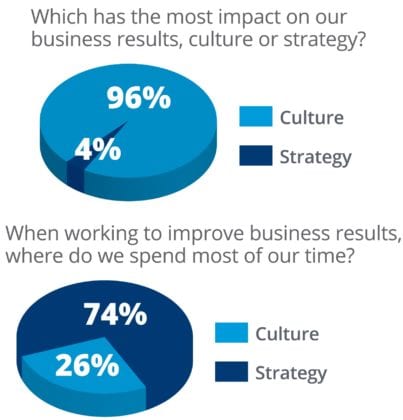
    All of these changes can be for naught if you don’t have the right culture in place. As the great Peter Drucker said, “Culture eats strategy for breakfast.” Yet, take a look at the data from a recent Partners In Leadership Workplace Study below:

    The majority of leaders spend most of their time on strategy, but readily acknowledge that culture has a greater impact on their business results. So what’s preventing them from working on culture?

    Operationalizing Culture

    Many leaders recognize the effort it takes to create a sustainable, positive culture, yet feel overwhelmed with everything else they have to focus on and see “culture” as just another thing they need to work on.

    Louis Gerstner, former CEO of IBM, shared what he learned over his career.

    “When I came to IBM, I probably would have told you that culture was                              just one among several important elements in an organization’s makeup                   and success — along with vision, strategy, marketing, financials, and the                 like. I came to see, in my time at IBM, that culture isn’t just one aspect of                   the game, it is the game.”

    If culture is the game, how do you go about winning the game? Building it into your game plan, operationalizing it. If culture is a process, then it holds that you would need to embed it into your processes, make it a part of your habits, routines and agendas.

    Three areas where culture should be showing up include:

    1. Meetings

    In team meetings, culture should show up on the agenda in a very specific, actionable way. In industries where safety is a key result and focus area, what do they start every meeting with? A safety moment! The same principle applies to culture: whether sharing a success story around your culture or recognizing someone for living the culture in a specific way, make culture a part of your meetings.

    2. Communications

    Consistent and deliberate communications across the organization that reinforce culture are vital. We aren’t talking about an initial cultural blitz of communications with posters and email blasts and branded pens (although those have their place). We are talking about consistent communication efforts over time. If the only time your organization hears about culture is when they receive an email from the VP of HR, they will probably see culture as a nice to have, not a must have.

    3. Systems

    Whether people systems, financial systems or operational systems, there needs to be alignment between our systems and the culture we are looking to create. Systems alignment or misalignment is a significant barrier to culture because people run into our systems every single day. The clichéd example is a sales team trying to drive teamwork and collaboration, yet they are incentivized purely off of their own results.

    Like anything in life that is worthwhile, shaping culture requires effort. As you focus your effort on building habits, routines and operationalizing your culture, it will have an impact, not only on engagement and morale, but results. As you focus on managing your meetings, communications and systems it will allow you to manage your culture, instead of your culture managing you.

    Mattson Newell is a Director for Partners In Leadership who works with leaders to create greater workplace accountability and facilitates enterprise-wide culture change.

  • Your Health Matters: 7 Tips to Better Sleep

     An excerpt from: 7 Treatment Strategies for Insomnia By Therese Borchard

    According to the National Center for Sleep Disorders Research, approximately 30 to 40 percent of adults report some symptoms of insomnia within a given year, and 10 to 15 percent report chronic insomnia. According to a 2015 study published in Psychology Research and Behavior Management, half of American seniors, aged 65 and older report sleep problems.

    Insomnia is one of the diagnostic hallmarks of clinical depression.  A high percentage of people who are depressed experience sleeplessness: interrupted sleep, difficulty falling asleep, and early morning waking. The relationship between sleep problems and depression is complicated because insomnia can also cause depression. According to a 2005 study published in the journal Sleep, people with insomnia were ten times more likely to develop depression and anxiety than those without sleep problems.

    It is best to treat insomnia as soon as symptoms surface. Here are some treatment strategies.

    1. Sleep Hygiene

    One of the first steps toward better sleep involves following rules of sleep hygiene, such maintaining a consistent schedule during the day; waking up at the same time everyday even if you didn’t sleep; using your bed for sleep and sex only; going to bed only when you are tired; avoiding naps, especially close to bedtime; exercising during the day, but not within three hours of bedtime; adhering to a bedtime ritual that involves reading, a bath, or some other relaxing activity.

    “Most people with chronic insomnia develop sleep-preventing behaviors and associations with the bedroom that make it more difficult to sleep,” writes Robert Rosenburg, D.O., in his Everyday Health blog, Sleep Answers. He uses a technique called Stimulus Control to try to break negative associations with the bedroom environment.  People are instructed to go to bed only when sleepy.  If they are in bed for 20 minutes and are wide awake, to get out of bed and do something relaxing in another room and when sleepy return to the bedroom.

    2. Cognitive Behavioral Therapy

    In cognitive behavioral therapy, a therapist helps a patient identify distorted thoughts and then reframe them into more realistic, positive statements. For sleep issues, this usually involves working with performance anxiety—the pressure felt to control the amount and quality of sleep. New ways of coping with stress are introduced, as well as strategies for reducing the typical frustration associated with sleep disturbances. A review in a 2015 issue of Sleep Medicine Research reported that CBT is effective at treating insomnia in patients with primary insomnia, but also in patients with comorbid symptoms of insomnia and anxiety disorders.

    3. Sleep Restriction

    Sleep restriction is often done as part of cognitive behavioral therapy. This strategy is designed to minimize the amount of time a person spends awake in bed. For example, a person initially goes to sleep very late at night, past a normal bedtime by a few hours. He or she always wakes up at a fixed time. The bedtime is progressively moved forward by increments of 10 to 15 minutes with a person’s sleep success. Patients keep a sleep log to help record progress.

    4. Erase Sleep Myths

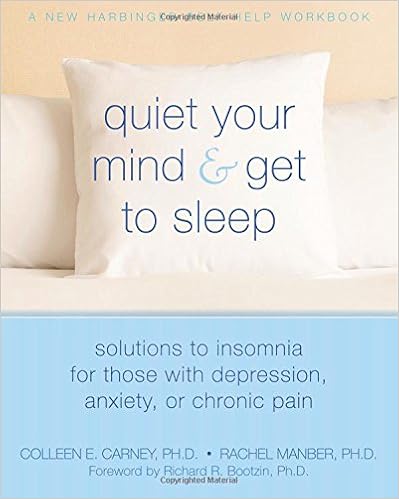
    In their book, Quiet Your Mind and Get to Sleep, authors Colleen Carney, Ph.D. and Rachel Manber, Ph.D. list several sleep myths that contribute to insomnia and sleep anxiety. Identifying them helped me to relax a little bit about my sleep. Among them are these:

    • Everyone requires eight hours of sleep to function during the day.Actually, there is a wide range of sleep needs, and the average amount of sleep needed for an adult is probably less than eight hours.
    • If you’ve had good sleep, you should wake up feeling refreshed. The truth is that after waking, it’s natural to spend up to 30 minutes feeling groggy. This is called sleep inertia or sleep drunkenness, which is transient and is likely affected by the sleep stage from which you were awakened.
    • If you wake up a couple of times during the night, even though you fall back to sleep pretty quickly, it must be having a negative effect. Not really. Brief awakenings are a normal part of the sleep process. In fact, the average number of awakenings per night is twelve. We are typically awake in bed for up to 30 minutes every night.
    • If you spend more time in bed, you’ll get more sleep and feel better the next day. Sleep quality is more important than quantity. In addition to interfering with the sleep driver and your biological clock, spending extra time in bed may increase depression.

    5. Find Sleep Support

    I have found that teaming up with others who are experiencing sleep problems can relieve some of the anxiety felt around bedtime. For example, I swim with two women who have had sleep issues for the last ten years. Seeing them go on with their day despite inadequate rest inspires me to continue to put one foot in front of the other when I’m dragging and know that I’m not alone in this battle. It’s also helpful to have a safe place to vent about the fatigue. The American Sleep Association has an online forum that offers support to persons with sleep disturbances. Depression forums, like Project Hope & Beyond and those at Psych Central, have also groups dedicated to persons who experience insomnia as a result of depression symptoms.

    6. Relaxation Training

    There are several relaxation training programs available today. Some involve progressive muscle relaxation. Others include mindful meditation, hypnosis, or guided imagery. Mashable published a good list awhile back. Personally, I like the meditations by Jon Kabat-Zinn, PhD, founding director of the University of Massachusetts Medical School’s Center for Mindfulness in Medicine, Health Care, and Society in Worcester, as well as its stress reduction program. Dr. Zinn’s voice soothes me more than any other meditation guide. A friend of mine swears by the meditations found on the free app CALM. Of course, you don’t need a guide to meditate. Sometimes just paying attention to your breath on your own — concentrating on your belly as it rises with each inhale and lowers with each exhale — or concentrating on a bodily sensation is a great way of calming yourself down.

    7. Bright Light Therapy

    Bright-light therapy involves sitting in front of a therapeutic bright-light box for anywhere from 20 to 60 minutes a day. For best results, the light box should produce full-spectrum fluorescent light at an intensity of 10,000 lux. The purpose of the light is to reset circadian rhythms, the body’s internal biological clock that governs certain brain wave activity and hormone production.

    Product Details
  • Your Health Matters: Meditation-Coping with Chronic Illness

    How Meditation Can Help You Cope with Chronic Illness

    Living with chronic illness is stressful. These types of conditions are often unpredictable and require a lot of changes to how you live your life, work, and interact with your loved ones. But it’s more than that. The simple act of being can be challenging as pain, fatigue, nausea, and other symptoms accompany your every breath.

    Meditation can help.

    What is meditation?

    In everyday speech, the word meditation can mean a number of different things. People might use it to describe daydreaming on a park bench or thinking deeply about a particular issue. However, the actual act of meditation is something very different. It is a practice of concentrating in a quiet way, focusing on the present moment. The goal of meditating is to reduce stress, help you relax, and foster personal or spiritual growth.

    There are a variety of traditions and techniques for meditation. Mindfulness-based meditation is commonly used in group and individual practice by people with chronic illness and other medical conditions. It is particularly well known for helping people in those communities deal with the stress involved in living with health challenges.

    Benefits of meditation with chronic illness

    Including meditation in your coping toolbox can help you live better with chronic illness, both physically and emotionally.

    Studies on meditation bear this out. One study of individuals with chronic conditions (arthritis, fibromyalgia, IBS) found that individuals who received training in mindfulness-based stress reduction, which includes meditation practice, experienced less pain, anxiety, and depression. A meta-analysis of a number of studies into the effects of mindfulness indicated that it has “the potential for helping many to learn to deal with chronic disease and stress.”

    How to meditate

    In order to meditate you don’t have to sit in the lotus position with your hands on your knees and the best posture seen since women gave up corsets. At its heart, meditation is about sitting quietly and focusing within. The best description I’ve ever heard of meditation was when I was speaking with the pain specialist Jan Carstoniu, M.D., as research for my first book, Your Life with Rheumatoid Arthritis: Tools for Managing Treatment, Side Effects and Pain. He described it as the following:

    • Sit down
    • Don’t move
    • Shut up

    It sounds simple, but as many simple things go, it can get a bit tricky. Although your physical self might be comfortable and still, your brain is likely to be racing. That’s normal — even the most experienced practitioners of meditation have thoughts galloping around in their mind when they meditate. The key is to not engage with the thoughts, just watch them pass by. That takes practice, but if you find yourself getting sidetracked by thinking about your grocery list or the stressful meeting with your boss earlier in the day, let them go and return to sitting quietly.

    It’s usually recommended that you meditate 20 minutes a day, but many people find that a bit daunting to begin with. Start with five minutes and work your way up as you are comfortable.

    Meditation and mindfulness can be very valuable additions to your toolbox of coping techniques and can help you live better with chronic illness. Whether you follow mindfulness-based techniques or other types of meditations probably doesn’t matter. What’s important is the practice of focusing inward to reduce stress, pain, and depression.

    Kicking Sick
    Your Go-to Guide for thriving with Chronic Health Conditions
    Why Does Mommy Hurt?:
    Why Does Mommy Hurt?: Helping Children Cope with the Challenges of Having a Caregiver with Chronic Pain, Fibromyalgia, or Autoimmune Disease