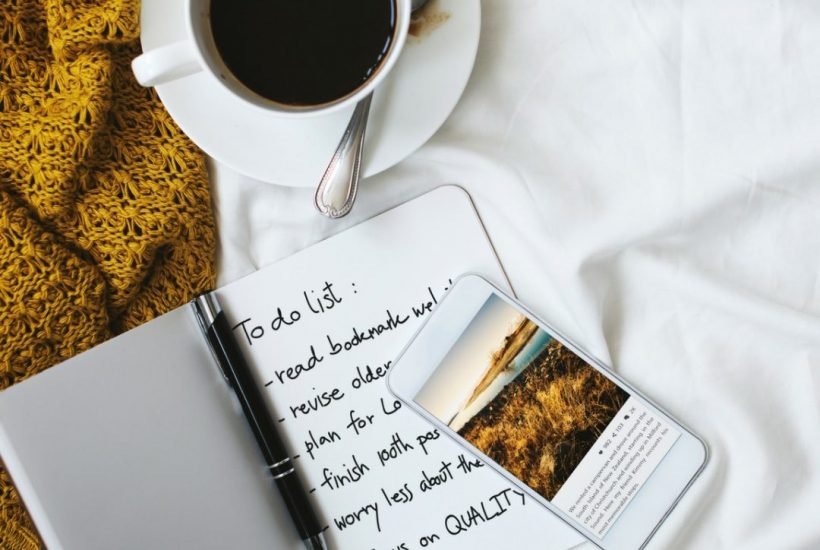
• Why Success Means Never Finishing Your To-Do List
    KATHERINE SCHAFLER       August 6, 2018   

    Here’s a list of things most people think they should be doing more of, see if you relate to any:

    ●︎ I should be working out more

    ●︎ I should be finishing my to-do list

    ●︎ I should be eating more healthfully

    ●︎ I should spend more time with my family

    ●︎ I should wake up earlier

    ●︎ I should spend more time on my appearance in the morning

    ●︎ I should watch less Netflix

    ●︎ I should shave my legs more often

    ●︎ I should have a cleaner house

    ●︎ I should spend less on going out to eat

    ●︎ I should be more present

    The list of “shoulds” traps you inside a hamster ball and makes you feel as if you’re scurrying through the day, banging into the wrong choices constantly and having to course correct every ten seconds. Do this repeatedly, and it gets very dangerous.

    Moving through your day feeling a constant pressure to be a better version of yourself causes you serious emotional harm.

    Moving through your day feeling a constant pressure to be a better version of yourself causes you serious emotional harm.
    Tweet

    Experiencing a chronic sense of inadequacy places you at greater risk for a depressive episode, not to mention makes you more likely to engage in those go-to self-destructive behaviors of yours that not only prevent you from feeling better, but actually make things worse.

    Carrie Bradshaw called this habit “should-ing on ourselves.” The slightly more academic version of this tendency was coined by the pioneer of feminine psychology, Karen Horney, who called this “the tyranny of the shoulds.”

    Horney supposed that we all carry two versions of ourselves, the real vs. the ideal. Dysfunction happens when the ideal is not seen as an ideal and is instead seen as who you should be. When you forget that ideals are not meant to be achieved, they are only meant to inspire, you basically spend the whole day feeling inadequate and like crap about yourself.

    When you forget that ideals are not meant to be achieved, they are only meant to inspire, you basically spend the whole day feeling inadequate and like crap about yourself.
    Tweet

    There are two things to keep in mind that might help you remove yourself from the hamster ball of personal inadequacy, recover from the dizziness and move in the direction of a more purposeful and fulfilling life.

    1. Don’t Let Your Real Self and Ideal Self Get Too Cozy

    Please keep in mind that conflating your real self with your ideal self reflects a dangerous loss of perspective.

    You need to recognize that one is fantasy and the other is reality. Another way to say that is that one is real and possible, while the other one is not.

    Instead of conflating, decide that you will err on the side of the ideal self when you feel up for it, and allow yourself to be your real self other times.

    But what if I never feel up for it? What if I ignore my ideal self and just live a life of underwhelming mediocrity?

    That won’t happen, because of another simple but brilliant psychological truth: you have a natural self-actualizing tendency.

    2. Trust You’ll Grow Naturally

    Yep, just like the tiny acorn is naturally built to grow into the mighty oak tree, you are naturally built to grow into your full potential.

    Just like the tiny acorn is naturally built to grow into the mighty oak tree, you are naturally built to grow into your full potential.
    Tweet

    You don’t have to do anything to make this process happen, except to get out of your own way. Your job isn’t to speed this process along, it’s to make sure the conditions are good so that what’s already set to naturally happen can unfold.

    Allowing your natural self-actualizing tendency to unfold looks like making sure you curb the self-destructive behaviors that reverse the self-actualizing process.

    It also looks like surrounding yourself with caring, thoughtful people who support you and believe in you. Perhaps most importantly, allowing your natural self-actualizing tendency to unfold entails supporting, believing, and trusting in yourself.

    Allowing your natural self-actualizing tendency to unfold entails supporting, believing, and trusting in yourself.
    Tweet

    Trusting in yourself can be surprisingly difficult and requires an inner script of reassurance and self-compassion.

    How to Start:

    Give yourself permission not to be your ideal self today.

    Maybe you have a picture-perfect vision of how ideal you would tackle that to-do list, pull off that 3rd grade birthday party, or navigate a presentation. Yes, use that vision to inspire you, but measure success as getting 80 percent there—not going all the way.

    What that also means: Give yourself permission to not feel guilty for not being your ideal self today. As Marissa Mayer has said: “Success is never getting to the bottom of your to-do list.” Why: Because she’s not about doing everything, but about doing what’s most important.

    “If I did (get to the bottom of the list) it would be a real bummer,” Mayer has said. “Because think about all those things at the very bottom of your to-do list that really shouldn’t take time out of your day.”

    Space will always exist between your real self and your ideal self—the one who gets everythingdone. But that’s the way it should be so we can keep reaching for more but still focus on what matters most.

    Space will always exist between your real self and your ideal self—the one who gets everything done.
    Tweet

    Aim high, but let your growth unfold on its own terms. And try to make self-compassion—not self-shame—the foundation of it all. You’ll be suprised at how much lighter growth can feel.

    A version of this article originally appeared on KatherineSchalfer.com

  • How to Unlearn Your Need to Be Liked

    Take a second and notice if you’ve thought one of these things today:

    ●︎ Do they like what I do?

    ●︎ Do they like what I say?

    ●︎ Do they like what I think?

    ●︎ Do they like what I create?

    ●︎ Do they like how I look?

    ●︎ Do they like me?

    If we could do a virtual “show of hands,” my guess is that everyone reading this would have one—if not two—in the air. Whether it’s at work, before you post that #beachday pic on Instagram, or even while tucking your kids into bed, these “Do they like me—do they really like me?!” thoughts love to pop up.

    Why: It’s human to want to be liked. Case-in-point: Even Beyoncé has dealt with a desire to be liked.

    It’s human to want to be liked.
    Tweet

    In a new interview for Vogue, the Queen Bey herself opened up about needing approval early on in her career:

    ”I look at the woman I was in my 20s and I see a young lady growing into confidence but intent on pleasing everyone around her. I now feel so much more beautiful, so much sexier, so much more interesting. And so much more powerful.”

    Yup, that’s Beyoncé saying that even she felt the need to make everyone around her happy.

    We Do It For the Likes

    So, why do we all care so much about people pleasing? Being liked is actually a fundamental human need, according to Roger Covin, Ph.D., a clinical psychologist.

    Covin explains in his book The Need to Be Liked that our need for social acceptance grew out of our desire to physically survive—back in the day, we had to build shelter, find food, and defend ourselves every single day. It was all a lot easier to do in a team. To join a crew: You had to either have a skill that would benefit the group and/or be liked by people in the group.

    Our brains haven’t caught up to the fact that we’re not defending ourselves from wild animals anymore—so we continue to people please. “In other words, we are hardwired to seek acceptance and avoid rejection,” Covin explains.

    And, as Beyoncé learned firsthand, it can keep us from unlocking our full potential.

    According to Psychology Today, our need to be liked can keep us from doing things that matter to us (but what will they think?), trying new things (but what will they think if I’m not good at it?), and, of course, lead to stress about meeting expectations (how can I make them like me?).

    Basically, it can stop us from finding and living as our true selves.

    You might be thinking: Sure, if I had the financial and creative freedom of Beyoncé, I could definitely stop people pleasing.

    Yes, we still have to get along with our bosses, our co-workers, Erin in accounting, our spouses, our subway companions. But here’s the thing: resisting your people-pleasing reflex isn’t about being rude or writing off responsibilities—it’s about going after things your way and for you (even a relationship or promotion or interaction) instead of chasing someone else’s kudos.

    Here, a few ways to start shifting from “people pleaser” to doing things for you:

    1. See Yourself as an Ink Blot

    The hard truth: Not everyone is going to like you. But a lot of the reason why has nothing to do with you.

    Covin told The Cut that the whole “do they like me?” game is similar to a Rorschach test. If you’re not familiar with the test: It involves showing someone an abstract inkblot and asking them what they see to learn more about their psychological state (ex. Two dogs high-fiving while wearing tutus). Everyone can see something different in the splotches of ink—and that’s similar to how people view you.

    “What a person sees says more about them than it does the inkblot, and the same thing is true interpersonally,” Covin told The Cut. “The very qualities that make you likable to one person are the exact same qualities that will make you unlikable to another person.”

    Basically, it’s not totally on you if someone likes you or not. And a number of factors can influence how a person sees you, even something as simple as how their day is going. If one person’s hungry, Covin says, it can even shift how they see you.

    “The very qualities that make you likable to one person are the exact same qualities that will make you unlikable to another person.”
    – Roger Covin, Ph.D.
    Tweet

    The whole “likability” thing is largely out of your control—so why shift all your behaviors to please others when just skipping breakfast could change their mind?

    2. Disapproval Is Normal

    It can also help to remind yourself that it’s normal not be liked by everyone. Robert Leahy, Ph.D., writes that “normalizing disapproval” can release some of the pressure to be liked.

    “Do you know anyone who is approved of by everyone they meet?” he writes. “If everyone has someone who doesn’t like something that he or she says or does—and they still survive and thrive—then why would you be the one person who has to have universal approval?”

    It’s a bit of tough love—but it can help break up the “Why don’t they like me?” thought pattern.

    3. Untangle Your Worth From the ‘Likes’

    When we tie our worth to likes from others—both real and digital—we lose ownership of our self-esteem, confidence, and all those good feels that can help us withstand not being liked.

    To help reset your perspective, Elliot D. Cohen, Ph.D., suggests reminding yourself that your worth doesn’t need approval. “Reframe the misguided assumption that approval will somehow bring you self-worth, dignity, and happiness,” he writes.

    Your worth doesn’t need approval.
    Tweet

    Try telling yourself: “I am a worthy person whether or not I have the approval of others.” Repeat it until it starts to feel true.

    4. Just Do It—For You

    The classic Nike saying “Just Do It” deserves a little addition to the end: “Just do it for you.”

    No, I don’t mean selfishly only do things that serve to benefit you—what I mean is pursue the things you need to or want to do in a way that is wholly you and driven by you. Even just mentally shifting what’s driving you from someone else to yourself can help.

    “When you’re driven to achieve solely because you want to impress others, you wind up doing too much, feeling overwhelmed, getting lost in your thoughts about your challenges, people-pleasing, overworking, avoiding making time for yourself, and constantly finding yourself unable to say no,” Ilene Strauss Cohen, Ph.D., explains for Psychology Today.

    Next time you’re trying to create or achieve something—whether it’s a work project or a new song on the guitar—step back and ask yourself: Who am I doing this for? Is it just to impresssomeone? If so, take note.

    Ask yourself: Who am I doing this for?
    Tweet

    If you’re in people-pleasing mode, try to reconnect with your why. Why do you want to see this thing through for you?

    Remember the reason you started—especially if it’s a creative endeavor.

    As David Bowie puts it, “Always remember that the reason you initially started working was there was something inside yourself that, if you could manifest it, you felt you would understand more about yourself.”

    5. Ask Yourself: What Can I Still Do If I’m Not Liked?

    Surprise: You can still live a big life if you’re not liked by everyone. If, say, that stranger in the elevator wasn’t into your morning banter, Leahy writes that reminding yourself of all the opportunities that still exist can help.

    “What can you still do (even if someone doesn’t like you)?” he writes. “Can you see your partner, your family, your kids, your friends, and your co-workers? Can you still engage in all the activities that you engaged in before? If you can pretty much can do everything you did before, then what difference does it make if someone doesn’t like what you say—or if they dislike you?”

    6. Start Small

    Finally, don’t expect yourself to get over your “people pleasing” tendencies overnight. Again, this thing is hardwired in us—so it takes time and practice to change it up. Beyoncé said it took her years!

    Start small by pursuing one thing a day just for you, not the approval, retweets, or likes of someone else.

    Maybe it’s watching that Netflix movie for youths (hey, The Kissing Booth) for the 10th time, even though your friends think it’s “garbage.” Or, maybe it’s remixing that daily task so it feels more you. Or, maybe it’s even belting “Halo” with the windows down and laughing at the looks from the people in the cars around you.

    “Start asking yourself questions like, what do I value? What keeps me awake at night? How is it that I prefer to spend my time?” Cohen suggests. “Start to listen to what you really want for your life, and align your actions with your values, principles, and goals. Instead of making decisions based on what others will approve of, start making them based on what’s right for you.”

    “Instead of making decisions based on what others will approve of, start making them based on what’s right for you.”
    -Ilene Strauss Cohen, Ph.D.
    Tweet

  • Why It’s Brave to Go at Your Own Pace


     By Patricia Marin February 1, 2018 

    You’re standing with a group of friends who are ready to do the next big thing, and it’s your turn. The problem is, you’re terrified. You made a resolution to be braver this year, but there’s an awful feeling in the pit of your stomach. Your friends keep saying that you’ll be fine and it will be a great experience, but you’re not so sure.

    When we’re tackling a new goal or challenge, people are often quick to give us advice like, “Just push yourself to do it!” and “Just dive in right away—don’t think!” Though they’re attempting to help, it can sometimes feel like peer pressure—like we’re supposed to radically reinvent ourselves right away, regardless of how uncomfortable it makes us feel. Yes, trying new things is an important practice in self-development, but one person’s quick change is another person’s months-long journey.

    What I’ve learned: The key is to step out of your comfort zone because you want to, not because everyone else is doing it. The power is in trusting your gut and your intuition.

    Real growth comes from making decisions for yourself.

    Today, I try new things for my own reasons and when I feel prepared to step out into the great unknown. I’ve learned not to give into peer pressure simply for the sake of appearing courageous. It’s not about waiting for your fear to disappear completely, but knowing when you’re ready to get outside your comfort zone. Real growth comes from making decisions for yourself.

    Here, three things I’ve learned about going at my own pace:

    1. Everything Isn’t For Everyone

    zipline snow

    Some people get a rush from living on the edge, but I’m not one of those people. One example: I have always been afraid of heights, though most of the time I wouldn’t admit it. So when a group of friends and I went zip-lining one summer, I thought I could handle it. But when I put on the harness and stood at the top of the precipice, looking out into the distance, I realized that this adventure may not be for me. I politely bowed out. Everyone tried to convince me to do it and said I’d regret it if I didn’t, but the idea of flying through the air thousands of feet from the ground did not sound like fun to me. In fact, I imagined that I would pass out mid-air from the intense fear I felt.

    I realized that the reason I was hesitant to say no wasn’t because part of me wanted to fly through the air—it was the pressure that the others were putting on me. I didn’t truly want to zipline. Once I stood strong in my decision, I felt relieved and proud of myself. I went back down the trail and watched my friends as they descended towards me.

    Afterwards, they said it was amazing. I was very happy for them, but I felt no regrets. I was glad I didn’t force myself to do something I was 100 percent uncomfortable with, and that’s what was important to me. Will I ever zip-line? Maybe. I just know that at that moment, I wasn’t ready and it was OK.

    2. Do It For Yourself—Not Someone Else

    white-dress-and-tattoo 925x

    Taking advantage of opportunities for growth is essential to life, but there are times when the people who are giving you the shot might not have your best interests in mind. Especially on the job, it’s hard to turn down opportunities for fear of stunting your career development, but sometimes that’s exactly what you need to do.

    One day, on a job where I was fairly new, I was approached by someone who had never shown interest in me or what I did there. She barely took the time to find out my name. She asked me to be a part of a video and, although I was nervous, it sounded like a great opportunity. Minutes after I agreed to do it, I discovered that the woman would not give me a minute to prepare and that I was the last resort after everyone else had turned her down. So, with this new information, I decided not to do it.

    The woman was so upset that she began to try to guilt me into doing the video anyway. But I stood firm in my decision to say no, especially after realizing that it was an experience that would potentially harm me. Starring in that video unprepared and flustered would have been a bad look for me professionally.

    If I had allowed myself to be bullied into doing the video, I wouldn’t have learned anything and would have left feeling used. Luckily, my gut feeling gave me the confidence to say no and stand my ground.

    3. Work to Your ‘I’m Ready’

    red clock

    When I was a child, my mom believed that being a shy introvert would have a detrimental effect on how I moved through life. She tried to help me get past my shyness by pushing me into situations that would take me out of my comfort zone.

    Though she was attempting to help, in many ways it actually made me feel more isolated and fearful. As an adult I now understand her good intentions, but growing up I spent many years resenting her and trying to crawl back into the shell that I regretted leaving.

    As children, it’s not really easy to say no to our parents when they are trying to teach us new skills. But as adults, we can learn to stand up for ourselves. There’s nothing wrong with saying, “No, I am not ready, but one day I will be” and then work on getting there in your own time.

    I carried my fear of social situations into adulthood, and, because of this, I hated networking events. But everyone said they were the only way to advance in my career, so I forced myself to go instead of working through my anxiety first. One day, I went to a very intimidating event and, instead of gaining contacts, I was paralyzed with fear. I vowed never to go to another event again.

    After a while, I realized I had to face my fear rather than trying to boldly push past it.

    After a while, I realized I had to face my fear rather than trying to boldly push past it. I learned networking hacks, like bringing a friend or making a game plan prior to an event, even rehearsing what I would say while there.

    Once I saw the value in making connections and felt ready personally, I started to go back to networking events and having more success. I was still super nervous and may have only spoken to two people at each event, but I didn’t let fear immobilize me. I was able to do it because I was ready—and I was finally doing it for me.

    It’s brave to step out of your comfort zone, but it’s brave to own when you’re ready for that moment, too. Remember: Real growth comes from making decisions for yourself. And you have the power to decide when you’re ready for your next leap into the unknown.

  • Cut 5 Unnecessary Spending Habits for 30 Days Watch What Happens to Your Bank Account
    Financial experts note that people tend to fall into two categories: savers and spenders. I’m the latter; I have a habit of making purchases based on what I want instead of what I need. To curb my impulsive “I can afford everything” buying mentality, I tracked my spending decisions over the past 30 days. Here’s what I learned—and how you can use these strategies to allow your dollars to add up in a more impactful way over time.

    1. Stop buying coffee every morning

    I’m a self-proclaimed coffee junkie. I love the smell of freshly ground beans, the first hot sip of french roast on a blustery winter day, the icy jolt from a tall glass of cold brew. I also love the ritual of stopping at a coffee shop on my way to work. It feels like a special treat, just for me, before diving into the hurried tasks of my day. Oh, and I’m a mom to an nine-month-old for whom sleep is optional, so there’s that.

    However, the cost of each barista visit adds up quickly. I realized that I was easily spending around $2-6 a day. On a beverage! If you do the basic math, that is something like $500-1500 a year. Considering that is the cost of a super sweet vacation, I challenged myself to stop buying coffee for 30 days and simply make it at home.

    The first week sucked. I longingly stared out the window at my favorite cafe every time I drove past, and then took a sip out of my to-go mug of coffee made at home, which was…fine. It still got the job done; I mostly experienced the natural lows that occur from being disciplined (sigh) instead of spontaneous (yay!). Instead, I saved coffee purchases for meetings or dates with other people—moments when I could linger, chat, and truly enjoy my beverage with great company. This resulted in many upsides, such as a reduced caffeine reliance, more money in my pocket, and a better appreciation for treat yo’ self days. (Hint: it’s not a treat when you get it every day!)

    Monthly savings: $60-180


    2. Limit dining out to special occasions

    Growing up, my family usually went out to dinner to celebrate specific events: birthdays, relatives in town, Christmas Eve after late night mass. We ordered pizza a few times a year on Friday nights, complete with watching new episodes on ABC’s TGIF and drinking Pepsi out of the can. If that sounds lame, it wasn’t—because I knew that dining out marked a special occasion. Somewhere along the way I forgot that, and eating out became the norm due to a hectic schedule, lackluster cooking skills, and a taste for convenience.

    Typically, I eat out for lunch 1-2 times a week, and my husband and I either pick up dinner or visit a restaurant 1-3 times, mostly on the weekend. That can cost anywhere from $8-15 for a single lunchtime outing and $20-75 for take-out or a sit-down meal, not to mention the fact that labor costs are rising, which has led to restaurant prices inching up. To save money for 30 days, I made a conservative choice to limit weekly dining out to one lunchtime outing on my own and one weekend dinner out as as couple. I wanted to see if I could retrain myself to view dining out as a special, cherished event, rather than an everyday occasion.

    The result? I didn’t notice much of a difference; I simply needed to do a bit more meal planning for work and home. I also felt better health-wise and had more energy. Sure, pulling out a tuna sandwich and an apple at my desk felt less exciting than the Whole Foods salad bar—but spending the extra cash on a nice steak dinner with my husband and our favorite bottle of pinot noir later that week was worth every penny.

    Monthly savings: $32-60 (by dropping one individual lunch per week) and $80-300 (by dropping one dinner for two per week)

    3. Stick to a List

    Otherwise known as, “how I avoided accidentally spending $100 at Target on shit I don’t need.” Even though the dollar section always calls my name and insists I need new notepads or decorative candles, I’m learning that if I actually stick to a legitimate list of items, I end up saving money. This approach proved useful at any store; before going on errands, I wrote down my list of items and then did my very best to only purchase those specific things. If I walked down an aisle and thought, “Oh! I forgot that I needed shampoo!” I asked myself if I was legitimately out of shampoo or if I was just running low. I discovered it was often the latter, and realized I could put shampoo, for instance, on my next shopping list. And at the grocery store, I learned that having a list kept me from buying (usually unhealthy) splurge items (like large packages of sour gummy worms).

    Was it less fun to shop that way? Well, yes. It feels limiting to buy what’s on your list rather than view a store as your oyster; however, I’m not made of money and need to stick to a budget. This helped, immensely. One surprising perk: I also saved a lot of time by sticking to a list because I didn’t aimlessly wander around the store every time; I got in and got out with the things that I needed.

    Monthly savings: $10-100

    Editor’s note: With online grocery shopping/pickup or delivery, you can save even more – you never step into a store, so you eliminate all “impulse buying”.

    4. Revive old-school fun

    Once I became an independent adult, my idea of fun shifted to events that pretty much always cost money: drinks, dinners, concerts, plays, vacations, classes, parties…it all had a price, and I wanted to see if I remembered how to have fun the old-school way. You know, for free. Turns out there were plenty of things to do, like walking around the local art museum with a girlfriend, or running an informal 5k with my sister instead of signing up for an official race, or watching Netflix at home with stovetop popcorn.

    At first, it felt a little boring, but mostly because my expectations were accustomed to thinking about activities as being Instagram-able first and foremost. I also felt a little self-conscious and lame by offering up alternative suggestions to friends who wanted to go out. But I got over it, and my friends never honestly seemed to mind because they just wanted to spend time together.

    There’s joy in the simple things, like hanging out with the people you love with no agenda or timetable or required five-course meal. At the end of the 30-day period, I desperately felt ready for a nice glass of wine at a fancy bar; I wanted to fill up my calendar with everything fun. However, this exercise taught me to be more creative, more present, and more appreciative of people instead of things.

    Monthly savings: $15-200


    5. Unplug – Take a break from your phone

    Earlier this year, I received a serious lecture from my husband about the fact that I went over our data plan pretty much every single month. This had become a massive habit of mine, and an expensive one since most cell phone carriers charge $5-15 for each GB of overage. To mitigate these unexpected costs, I forced myself to shut off cellular service for all applications unless I had access to Wi-Fi.

    I soon noticed that I absent-mindedly checked my phone alllll the damn time. Usually for no good reason whatsoever. Additionally, I used GPS when I didn’t need to (I mean…I know how to get from my sister’s house to my apartment) and browsed Spotify to my heart’s content during long car rides. And social media? I opened those apps constantly, just to look and basically distract myself from real life whenever I felt bored, lonely, or anxious. I also, gulp, came face-to-face with my penchant for grabbing my phone while driving, which is incredibly unsafe. I thought I was being quick at a stop light to glance down at my email, when I was really just making life on the road unsafe for myself and others.

    By putting my phone down, leaving it in my purse, or setting it aside, I not only saved money each month, I also had the opportunity to be much more aware on a daily basis. My emotional state improved, since I wasn’t continuously comparing my life to virtual reality. The data savings were great, but I felt grateful to kick a bad habit along the way.

    Monthly savings: $5-20

    The bottom line: Cutting these five items from my monthly budget taught me valuable lessons and put hundreds of dollars back into my bank account. Most importantly, it reminded me to make more meaningful, thoughtful financial choices, such as making extra student loan payments, money saved for a down payment on a house, and more bulk to my savings.


    What are simple ways you’ve learned to save money on a daily basis? Where do you still struggle with want vs. need?

  • Stop Overthinking: 7 Easy Ways to Kick This Bad Habit
    LIFE & WORK SKILLS   
     Overthinking is like doing jumping jacks — lots of movement but going nowhere. And it’s just as exhausting.
    We’ve all been there: Everyone overthinks situations from time to time. Sometimes, it’s beneficial to think things through; by looking at a situation from all angles and weighing the options, we can move forward with confidence. But overthinking can also become chronic when we repeatedly rehash past situations and second-guess every decision. This kind of overthinking can make us moody and anxious and prevent us from getting anything done.“Worrying is a human problem, and it’s normal to try and resolve those worries. But it’s important to manage this mindset,” says Linda Benjamin, a clinical social worker and self-proclaimed worrier. “If you don’t tackle your worries, they become bigger and more fearful. You make a place for the worries in your mind.”

    If you’re stuck in your own mind loop, here are some ways to free yourself from overthinking.

    1. Pause.

    The key is to notice when you start to overthink, says Benjamin. The first step in addressing the habit of overthinking is to recognize when it’s happening. When you start to feel anxious or doubting, take note of how you’re responding.

    2. Do Something Different.

    Allow yourself to own how your feeling in the moment, but recognize when your mind is going into overdrive and do something about it. In other words, distract yourself! This could be anything from reading a good book, watching Netflix, cooking, or going for a walk.

    3. Challenge Your Fear Of Failing.

    If you find yourself overthinking a decision at work or worrying about a potential outcome, consider that your fear of failure may be holding you back from success. It’s time to pass on perfection — in reality, those who don’t make mistakes are unlikely to make anything at all. Embracing the possibility of failure gives us the freedom to try.

    4. Think About What Can Go Right.

    Overthinking tends to be negative and self-defeating. Rather than ruminating on all the possible ways a situation could go wrong, consider what could go right.

    5. Put Things In Perspective.

    It’s easy to make things bigger and more negative than they need to be. This is especially true of creatives, whose active imaginations can construct vivid, worry-filled scenarios. But if you take a moment to really think about the situation and its place in the bigger picture of your life, will it really matter in a year? Five years? Ten? Simply setting a timeframe can ward off overthinking.

    6. Practice Gratefulness.

    It’s impossible to have a grateful thought and a regretful one at the same time, and making time to practice daily gratefulness can help your mind “change the channel” to the positive. Jot down what you’re grateful for so you can look back on all the good things around you.

    7. Repeat…

    Because the habit of overthinking will creep up again. And that’s okay, says Benjamin. “The tendency to overthink may never go away, per se, but it is something that can be controlled in time, something you can help yourself with. Life is short; it’s nice to be there when it happens.”

    Do you tend to overthink? What are your strategies for working through it?