
• Why Some People Succeed Almost All the Time

    LARAE QUY 

    The reason why some people succeed almost all the time is that they understand their core strengths. They don’t waste precious time.

    When it comes to success, it’s easy to think that people who are blessed with brains are the ones who will make it to the top. Common sense suggests that being smart inspires confidence. It does for a while, but only while the going is easy.

    The deciding factor in success is how you handle setbacks and challenges. People who are convivial and pleasant even in hard times tend to attract the right people around them. With the right people come the right opportunities.

    There is a reason why some people succeed almost all the time, and it has little to do with being smart. Instead, they develop personal habits that carry them through setbacks and challenges. They use mental toughness to master the art of discipline and become the right person at the right time.

    Here is a list of personal habits for you to cultivate as well:

    1. Forget Self-Improvement

    The reason why some people succeed almost all the time is that they understand their core strengths. They don’t waste precious time trying to fix their weaknesses. Too much popular self-improvement tries to build up a skill set or talent that is lacking.

    Identify your strong character strengths and skill sets. Think about how you might use those strengths at work, in relationships, and at home. You’re also less likely to experience depression and other anxiety.

    TIP: Bask in what is already great about yourself rather than try to fix what is not.

    2. Savor “Me” Time

    The reason why some people succeed almost all the time is that they understand the value of time. They direct their efforts toward the most important things in their life. It is important that they impose effective time management skills and learn how to say no.

    They prioritize what needs to be done from what would be nice to get done. People who savor “me” time are very good at cutting out toxic relationships that add no value. Small acts of self-care do not need to take up giant blocks of time. But it is important to allow yourself to indulge in the stuff that brings you joy.

    TIP: Spend a little time and write down the things that bring a smile to your face. Find ways to incorporate these small acts of joy into your daily life.

    3. Develop A Back-Up Plan

    The reason why some people succeed almost all the time is that they don’t leave things to chance. They have a back-up plan—for just about everything. From electrical outages to failed business plans, they create strategies that will help them move forward.

    One of my favorite lines comes from The Eiger Sanction, a movie starring Clint Eastwood in which 5 men plan to climb the Eiger in Switzerland. Eastwood asks one of the climbers about the back-up plan in case they need to retreat. The climber replies, “I consider it self-defeating to plan in terms of retreat.” Eastwood’s character responds with, “I consider it stupid not to.”

    TIP: Always have a Plan B to fall back on when things go wrong. And have other people available to help you execute it when the time comes.

    4. Know What Makes Them Tick

    The reason why some people succeed almost all the time is that they pursue things that bring them value and meaning. They’ve figured out what makes them tick, and they go for it. They edit the stuff that detracts from their pursuit.

    Often, they make an extra effort to educate themselves about different issues and topics. This doesn’t mean they have loads of formal education, but they are curious.  Most likely, curiosity is what alerted them to their passion in the first place.

    TIP: Find something that provides you with value and meaning. It might be related to your job, or it might not. It isn’t always important to get paid. But do put your gift to use.

    5. Unafraid Of The Unknown

    There was a shepherd boy named David. He was not a warrior and he was small. David looked at a giant named Goliath and said “I will strike you down and cut off your head. ” That is exactly what he did. Challenges are only as big as we make them.

    The runt of the litter takes on the giant. We love stories of the underdog who musters the courage and confidence to find ways of beating the odds!

    According to the story, David ran toward the giant. As Goliath moved in for the kill, David noticed a gap in the armor that protected Goliath’s head. David reached into his bag and slung one of his stones. It struck on the forehead, the giant fell down on the ground.

    6. Cultivate Kindness

    The reason why some people succeed almost all the time is that other people like being around them. They attract other people who succeed almost all the time!

    Being a good citizen can increase your level of contentment. It doesn’t have to be anything big, but small acts of kindness can change your mental outlook. If the man standing behind you in the grocery line looks hungry and is buying one item, let him go ahead of you. Give someone a compliment.

    What goes around comes around. If you are kind to others, there’s a decent chance you’re kind to yourself as well.

  • 100+ Icebreaker Questions for Interviews

    CAREER CONTESSA EDITORS 

    This article first appeared on Careercontessa.com

    JULY 10, 2019

    The right icebreaker questions can be great for interviews. There are many illegal questions, make sure that you are not crossing dangerous boundaries.


    Icebreaker questions are more than small talk. These are targeted questions that usually require a moment of pause to consider—and answer. Typically, icebreakers yield entertaining and interesting answers. The goal of icebreaker questions is to loosen up a group of people—so that they can get comfortable talking to each other. Since we are all about expanding our soft skill sets, like communication, we decided to put together a list of icebreaker questions—and we got a little carried away.

    Delight your audience at your next meeting, networking event, or family gathering by preparing a few icebreaker questions to get conversations rolling! Here are 100+ icebreaker questions. Let’s get to bonding!

    Pro-tip: The right icebreaker questions can be great for interviews. However, since there are many illegal interview questions, make sure that you are not crossing dangerous boundaries. Questions around age, gender, religion, or race are illegal. Make sure your icebreaker questions are not inappropriate in an interview setting. If there is any doubt, stay away from icebreaker questions during an interview.

    EXPERIENCE ICEBREAKER QUESTIONS

    • How many states have you been to?
    • What was the name of your first pet?
    • What’s the longest flight you’ve ever taken?
    • What’s your favorite family tradition, past or present?
    • What’s the longest distance you’ve ever walked/run?
    • What is the best trip you ever took and why?
    • What was the first record you ever bought?
    • What color was your childhood bedroom?
    • What’s the scariest ride you’ve ever been on?
    • Who was your role model as a kid and why?
    • When did you first feel like an adult?
    • What is the last natural body of water you swam in?
    • What was the hardest class you ever took?
    • What’s a fact about you that nobody would guess?
    • What’s the worst misspelling of your name you’ve ever seen?
    • What was the first concert you went to?
    • What was the last concert you went to?
    • Where is the strangest place you’ve ever fallen asleep?
    • Do you have any strange or regional names for things where you come from?

    PERSONALITY ICEBREAKER QUESTIONS

    • If you had to create a slogan for your life, what would it be?
    • What was your childhood nickname?
    • What is the last show you binge-watched?
    • What’s something that everyone else seems to love—that you don’t understand?
    • If you could go anywhere in the world right now, where would it be?
    • What three words describe you best?
    • What always makes you laugh?
    • What’s your first memory as a child?
    • What is the best piece of advice you’ve ever received?
    • Do you collect anything?
    • What celebrities share your birthday?
    • When was the last time you turned your phone off or left it at home?
    • What was the first thing you remember saving up money to buy on your own?
    • What three words would your best friend use to describe you?
    • When you were a kid, what did you want to be when you grew up?
    • What is the scariest fear you’ve ever conquered?
    • What physical thing (hurricanes, bugs, heights) scares you the most?
    • Would you rather have a small dinner party with your 5 closest friends or a giant party with everyone you know and love?
    • Do you love or hate surprises?
    • What’s the best gift you’ve ever given to someone?
    • What quality about yourself would you like to pass on to your child?

    THEORETICAL ICEBREAKER QUESTIONS

    • If you could invite three people to dinner—living, dead, fictional, or real—who would they be?
    • If you had a paid year off work, how would you spend it?
    • What does your perfect ice cream sundae look like?
    • If you could read one book over and over for the rest of your life, what would it be?
    • If you could eat one food for the rest of your life, what would it be?
    • Would you rather be able to fly or be invisible?
    • If you could travel to any time period (backward or forward) where would you go?
    • If you were an animal, what would you be and why?
    • If you could guest star on any television show, what would it be? Who would you play?
    • If you could instantly learn any skill, what would it be?
    • If you were an Olympic athlete, what would be your sport?
    • If you could (safely) visit any planet, which would it be?
    • If you could commission any artist (living or dead) to create art for you, who would you choose?

    FAVORITE THINGS QUESTIONS

    • What are your top three favorite songs ever?
    • What’s your favorite movie and why?
    • What is your favorite television show and why?
    • What is your favorite way to unwind?
    • What is your favorite book that was read to you as a child?
    • What is your favorite book you read in school?
    • What is your favorite book as an adult?
    • What is your favorite cuisine?
    • Who is your favorite comedian?
    • What’s your favorite sports team?
    • What’s your favorite cereal?
    • What was your favorite Halloween costume you ever wore?
    • Who’s your most/least favorite Disney princess? We know you have one.
    • What’s your favorite comfort food?
    • Who is your favorite actor/actress?

    THIS OR THAT QUESTIONS


    • Deep sea or outer space?
    • The Beach Boys or The Beatles?
    • Hogwarts or Middle Earth?
    • Thunderstorms: scary or thrilling?
    • Spring, summer, fall, or winter?
    • Salty or sweet?
    • Yoga or running?
    • Coffee or tea?
    • Cat or dog?
    • Day or night?
    • Pancakes or waffles?
    • Rain or snow?
    • Train or plane?
    • Ski, snowboard, or surf?
    • Beach or mountain?
    • Cook a meal or clean up after a meal?
    • Hamburgers or hot dogs?
    • Friends or Seinfeld?
    • Steve Urkel or Kimmy Gibler?
    • Chocolate or vanilla?
    • Water or milk?
    • Breakfast or dinner?
    • Comedy or drama?
    • Hot or cold?
    • Halloween or 4th of July?

    PHILOSOPHICAL QUESTIONS

    • What would you like to be known for?
    • What do you think is the greatest invention in your lifetime?
    • What is one life lesson you will never forget?
    • What’s your personal heaven?
    • What are your parents’ best qualities?
    • What, in your opinion, is a fundamental characteristic of a good person?
    • Do you believe in luck?
    • What do you think dreams are?
    • There are now 25 hours in a day—how do you spend the extra hour?
    • What was the best part of your day today?
    • What is typically your favorite part of a day off from work?

    Do you have any great icebreaker questions you like to use? Let us know and we’ll add them to the list!


  • Is This What Success Looks Like?

    It’s Time to Stop Wearing Burnout as a Badge of Courage

    STEPHANIE JADE WONG

    Close your eyes and imagine yourself sprinting while holding your breath.

    Sounds tough, right? But that’s what leadership coach Lenore Champagne Beirne used to do when it came to her work—she’d push herself past her breaking point, thinking it’s what “success” looked like.

    “I’d tell myself it must be done with no breaks or forgiveness,” the 30-year-old Brooklynite tells Shine. “I’d go totally over the top and make unrealistic demands of myself.”

    Sound all too familiar? It’s pretty easy for a balanced hustle to slip into a not-so-balanced endless sprint. And we tend to see giving 110% 24/7 as evidence of working really hard—of pushing ourselves to do our best. But as Lenore learned, it’s really a recipe for burnout, not success.

    “If you sprint while holding your breath, you’re never going to be able to run another race because you’ll exhaust yourself,” Lenore says. “You’ll be more effective if you take in your needs to fuel you.”

    Burnout as a Badge of Courage

    Whether you’re juggling school and work, balancing family and friends, working on your side hustle, or staying up late to finish tasks you planned to finish hours ago—all of it takes a toll on your body and mind, even if it feels productive or a mark of hard work.

    “Unfortunately, we assume the fact that we’re exhausted means we’re doing something right,” Lenore says. The good news: Exhaustion isn’t the only option. “It was only when I started to see that work doesn’t have to be hard and painful that I started to notice it was more effective to detangle exhaustion as evidence for being on the right track or working really hard.”

    “Exhaustion isn’t evidence for being on the right track or working really hard”
    – Lenore Champagne Beirne

    You know your work habits and body best—which means you can know exactly when burnout is brewing. And the more you pay attention, the more patterns you can see. Once Lenore got curious, her burnout triggers became obvious.

    “I used to often find myself immobilized or unable to continue working,” Lenore says. “It was only after I had perspective to acknowledge burnout that I saw the patterns better and the work style that leads me to burnout.”

    Predict Your Burnout

    So, how can you predict your burnout? Lenore suggests an exercise called The Overwhelm Cycle, which she learned while she was training as a coach at Accomplishment Coaching. It’s a chart you can customize to help you recognize your burnout cycle.


    “We each have predictable ways of behaving,” Lenore says.

    Here are her steps on how to create your own Overwhelm Cycle:

    Step 1: Grab a sheet of paper and something to write with.

    Step 2: Draw a circle that represents a clock. Start at 12 o’clock, which represents total burnout.

    “Own whatever that looks like for you,” Lenore says. “Whether it’s being unable to do anything but lay down and binge-watch TV, or being hospitalized for exhaustion.”

    Step 3: Go back to 11:30. Think about what happens right there, before you hit total burnout mode.

    “For me, that could be taking on one more commitment than I know I’m able to take on, or agreeing to do things I’m not excited about doing,” Lenore says.

    Step 4: Work your way backwards around the clock.

    This predictor wheel shows you where you stand in your personal cycle of burnout. When you see that you’re at 6, you can make note of that and try to get yourself back to 1, instead of moving forward to 7.

    “If you know your cycle, you can change it rather than go back to the patterns you’ve always had,” Lenore says.

    And if you start to see yourself slipping towards burnout o’clock, here are three tips from Lenore on how to treat and beat burnout.

    1. Find Your Support System

    hug

    “We can feel like we get tunnel vision or like we’re going through this alone,” Lenore says of burnout. “Getting the support you need, whether it’s sharing a couch with a friend while you watch TV or something more formal is a major thing.”

    Lenore coaches people dealing with burnout all the time. Her first suggestion: Get a support system in place.

    “Support gets a bad rap,” she says. “People think something’s wrong with you if you need help, but I don’t think that’s true.”

    Be flexible with what “support” means—perhaps you’d prefer just hanging with a friend and not even mentioning burnout rather than sitting someone down to specifically discuss it.

    “Connect with someone who knows you’re valuable regardless of the results you produce,” Lenore says. “Burnout is related to our habit of telling ourselves we have to demonstrate value by doing something extraordinary. Instead, be with someone who gets that you’re awesome for who you are.”

    2. Build in Breaks

    woman taking a coffee break on phone

    If you do nothing else, at least give yourself a break!

    “A huge part of burnout is mental, so if you notice you’re getting yourself to create results by being rude to yourself—your inner critic is really loud and you’re being your own drill sergeant—noticing that and easing up on it when you hear it can change the way you experience work,” Lenore says. “You can do the same amount of work and get burnt out or not based on the internal dialogue you’re having or not having.”

    “You can do the same amount of work and get burnt out or not based on your internal dialogue.”
    – Lenore Champagne Beirne

    3. Make a List

    writing in notebook

    When we’re on the path to burnout, we can feel like we have to do all the things at once—and they’re all high-priority tasks. One of Lenore’s favorite things to do: Get someone to help her make a list of things that really have to get done and what may not take as much precedence. She emphasizes the importance of doing this exercise with someone you can be honest with, like a friend, family member, therapist, or co-worker.

    “Half the reason you landed here is because you’re in an extreme situation and have tunnel vision of what’s required of you,” Lenore says. “When you burn out, you have a hard time separating what’s factual versus what that means.”

    For example: If you miss a deadline, that’s a fact. You might interpret that as a failure, but someone with another perspective can help you see that you can ask for a deadline extension or that you may have just taken on too much at once.

    “A partner is a fact checker for you to make sure you got your eyes on what’s real, rather than negative inner dialogue that comes through when you’re burnt out,” Lenore says.

    Ready to put down that burnout badge and focus on more self-care? Trust: You’ll get more done in the long run.

  • The Type of Burnout We Rarely Talk About

    MARTHA TESEMA

    Do what you love and you’ll never work a day in your life.”

    That saying—one of the many by the great unknown—has been floating around on the Internet for as long as I’ve been googling “inspiring quotes” (a long, long time).

    It sums up an ideal situation: find a job that aligns with your values, and it won’t feel like a job at all. Sounds amazing—in theory. But it wasn’t until recently that I realized I had blindly followed the wisdom of this mysterious person without recognizing that it didn’t necessarily work for me.

    Doing what you love and pouring all your energy into it may be the key to someone else’s happiness. But when I turned what I loved—my passion for photography—into my 24/7? it took away the fun of what lead me to it in the first place.

    Instead of finding joy whenever I picked up a camera, my outlet became an all-consuming and energy-sucking endeavor. I started losing sleep, getting frustrated and overwhelmed by a wiped-out feeling. “This is your dream!” I would tell myself, as I stayed up late editing hundreds of photos from a day of shooting. And while it still may be, it turns out I was experiencing a certain degree of burnout we rarely talk about: passion burnout.

    The Perils of Passion Burnout

    burnout3Burnout was first coined by psychologist Herbert Freudenberger in the 1970s, and, back then, it applied to doctors and nurses—or professions that served others.

    Today, burnout is widely accepted as “the consequences of severe stress” that can be experienced by anyone. It also looks and feels different for folks with different identities and life experiences, as BuzzFeed’s Anne Helen Petersen examined in the follow-up to her viral expose on millennial burnout.

    But passion burnout is also a very real thing, shared across generations. It’s when that quote—“do what you love…”—goes totally haywire, and you end up dreading the thing that you fell in love with because of mental and physical exhaustion. It’s what happens when you go hard—but don’t necessarily go home, ever.

    Passion burnout is when that quote—’do what you love…’—goes totally haywire, and you end up dreading the thing that you fell in love with because of mental and physical exhaustion.
    Tweet

    In 2016, researchers dived deep into whether or not certain levels of passion impacted how employees experienced burnout. In their study, they broke down passion into two different types: harmonious passion and obsessive passion.

    Harmonious passion is when your work is motivating because it brings a certain level of pride and contentment. Those who experience harmonious passion find their work to be a key part of them but still reported that they found time to take breaks outside of the day-to-day hustle.

    On the other hand, obsessive passion occurred in people who were passionate about their work because of status, money, or other rewards, as reported by Inc. Their research showed those that found themselves falling under the “obsessive passion” category experienced burnout more than those under the “harmonious passion.”

    But if you’ve shifted from a “harmonious passion” to an “obsessive passion”—don’t worry. Recovering takes work and time, but research shows it’s definitely possible.

    Here are some steps to take to recover from—or avoid—passion burnout.

    Remind Yourself of Your ‘Why’

    It’s easy to get lost in the hustle of every day, so taking a step back to remind yourself of why you have a passion for something is key to shifting to a more “harmonious” state.

    Try remembering the beginning, when you first discovered your passion, and write down the feelings you experienced then. Hold onto these, and try to find ways to spark them once more in your life.

    It’s also important to take note of why you might be feeling burned out, whether it’s with work, a hobby, a side-hustle, or even a friend or partner. Write down negative feelings you have towards that thing that’s now overwhelming—without judgment—and notice what might’ve tipped you into burnout.

    Write down negative feelings you have towards that thing that’s now overwhelming, and notice what might’ve tipped you into burnout.
    Tweet

    For me: Skipping sleep to edit photos left me feeling sluggish and cranky—not energized like I usually get from working on my photos. That was my sign to cut back on the late-night editing hours, even if it feels productive at the time.

    The Magic Words: ‘No’ and Balance

    While a certain level of obsessive passion can come in handy, like when starting a side-hustle, it’s important to keep things in perspective and actively work to reign your burnout1energy in when you feel spread too thin. That’s where your trusty friend “no” comes in to help you set boundaries.

    And in the case of passion burnout, that might mean saying “no” to yourself. Sure, you’d love to work on that presentation or song on your guitar for 14 hours straight or have a marathon catchup session with a friend. But if it means sacrificing taking care of yourself, it’s best to say “no” and/or dial back your plans to create more balance.

    By creating personal and professional boundaries, you’re protecting your energy and ensuring that you’ll have time to take breaks and prioritize other areas of your life that might need attention, too.

    Quit The Comparisons

    Have you ever scrolled through Instagram or Twitter and feel bad at the sight of other people living out their dreams with what seems like so much ease? I can’t be the only one.

    Remind yourself that social media is a highlight reel, and not all energy is created equal. Maybe your friend from college truly thrives on that 80-hour #livingthedream work week—but that doesn’t mean you have to force yourself to do the same. Just like balance looks different for all of us, so does acting on our passions.

    Maybe your friend from college truly thrives on that 80-hour #livingthedream work week—but that doesn’t mean you have to force yourself to do the same.
    Tweet

    Whenever those “If I’m truly passionate, I’d be working as hard as them” thoughts creep in, try focusing on small wins you’ve accomplished recently. Shifting your thoughts into positive ones can combat the slippery slope of negative thinking that burnout can cause.

    Sleep Over Everything

    sleepWhen we don’t have enough sleep, every small hiccup and challenge can feel 10x worse than it is in reality. Sleep helps us think clearer, and studies have proven that too little sleep is a direct factor in burning out fast.

    Take time to optimize your sleeping schedule by starting small—like slowly creating an evening routine to lull you into sleep. Maybe it’s a cup of tea before bed or a chapter of a book. Whatever works for you, stick with it and it can help you wake up with a more focused mind and healthier outlook.

    Bottom line: You can run on passion—but you can’t run on passion alone. Trust that taking small breaks from that thing you love will help you sustain that love, not derail it.

  • How a ‘Pressure List’ Helps Me Keep My Stress in Check

    “I just feel like I’m under so much pressure.”

    I said those words to my mom during one of our recent weekly phone chats, after I’d ranted for a few minutes about how stressful my day/week/month felt. And, in her motherly wise way, her response was, “Well, where’s the pressure coming from?”

    At that moment, I realized: I didn’t really know.

    I could say that there was pressure from work, from family, from friends, from the world at large—I could make up some great dramatic similes about how my stress felt “like a backpack full of rocks that keeps getting heavier” or “like those frantic final moments on Chopped when your dish with Sour Patch Kids just isn’t coming together.”

    But when asked to pinpoint the exact things that felt stressful, I drew a blank. And not knowing what stressed me out made me feel even less in control. So that evening, I pulled out my journal and did an exercise that actually helped me figure it out.

    Under (Two Types of) Pressure

    Before we get into the exercise (stick with me—it’s a good one), it’s important to know there are two types of pressure we can feel: external and internal.

    pressure releaseExternal pressures are those that come from the world around us—our partners, our bosses, our email inbox, our family, our pets. It’s those thoughts like “Yikes, I need to respond to that urgent email” or “Shoot, I need to buy that thoughtful gift for the birthday brunch.”
    Internal pressures, on the other hand, we create in our own minds and bestow on ourselves like little stressful gifts. “These include all the inner ‘shoulds,’ ‘musts,’ and ‘have-tos,’” Rick Hanson, Ph.D., writes on Psychology Today. “Like: ‘I must not look bad.’ Or: ‘I can’t leave the house with dishes in the sink.’”

    Internal pressures tend to come from our internal fears, a sense of uncertainty, or our beliefs about how we should exist in the world.

    Our brains constantly track these external and internal expectations, rewarding us when we accomplish them and stirring up stress and pressure when we don’t meet the demands we set for ourselves.

    Our brains constantly track external and internal expectations, rewarding us when we accomplish them and stirring up stress and pressure when we don’t meet the demands we set for ourselves.
    Tweet

    Yes, some of this pressure is beneficial—it can motivate us to tackle our goals and be a supportive partner or friend, Hanson explains. But too much pressure—and unrealistic pressure—can create a cycle of self-shaming that leads to all the stress.

    Plus: We’re great at spinning up and tracking pressures that don’t really exist, especially when it comes to internal pressure. “Be aware of the ‘shoulds’ and ‘musts’ muttering—or shouting—in your mind,” Hanson says. “Are they really true?”

    Time For a Pressure List

    Knowing this, I decided to create what I’m calling a Pressure List to debunk and rationalize some of my pressure.

    Why: Research shows that journaling can help us better understand ourselves and process our stress.

    When we write things out, our left brain (the more analytical side) and right brain (the more emotional side) are able to work together to help us make better sense of how we feel, according to Psych Central. Also: Even just writing out how you feel is proven to make emotions less intense.

    When we write things out, our left brain and right brain are able to work together to help us make better sense of how we feel.
    Tweet

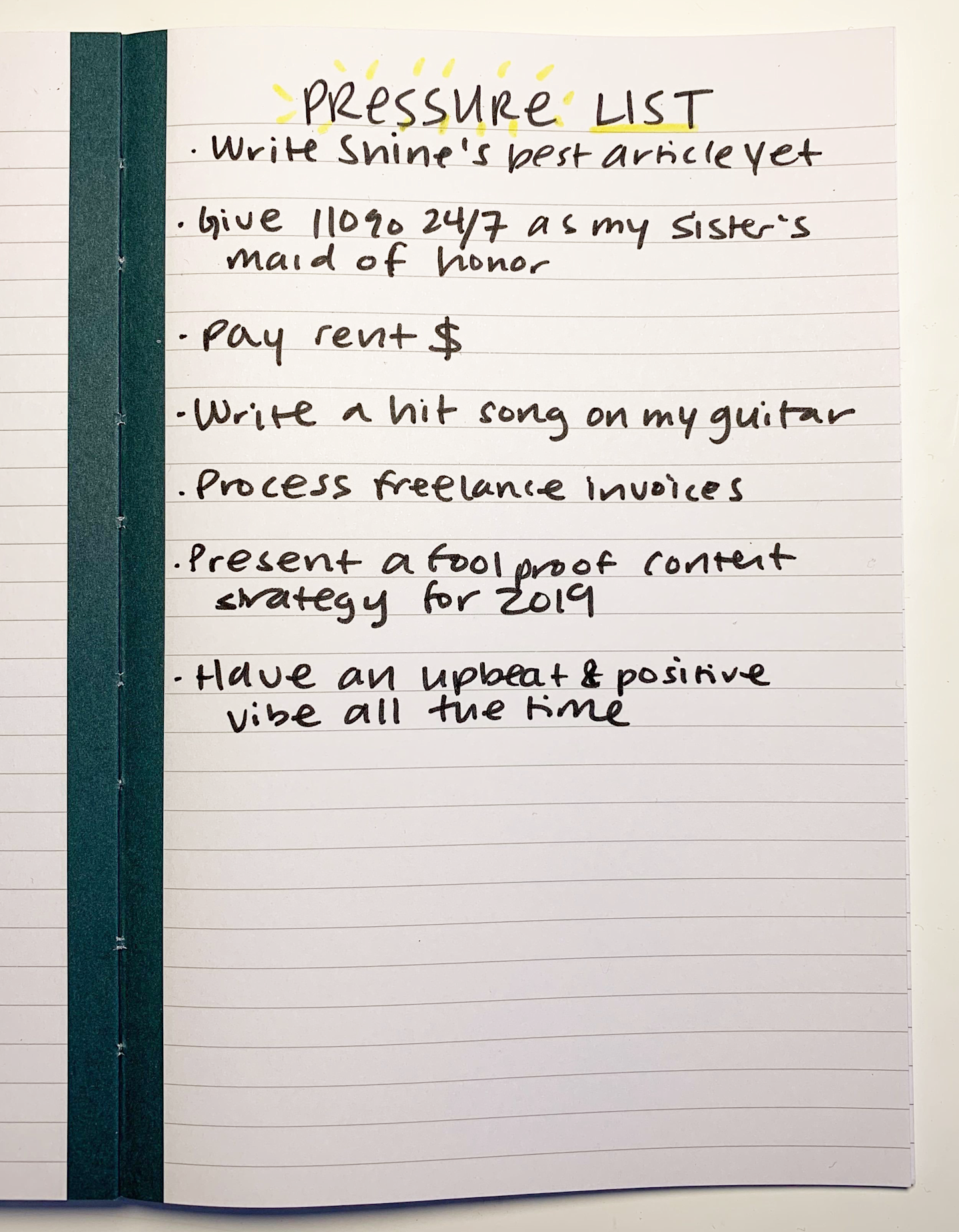
    To start, I gave myself a few minutes to list out some of the pressure I felt like I was under—without judgment. Here’s what I found:

    pressure-list-1Even just writing it out, I started to feel a little bit better—it wasn’t all just in my head.
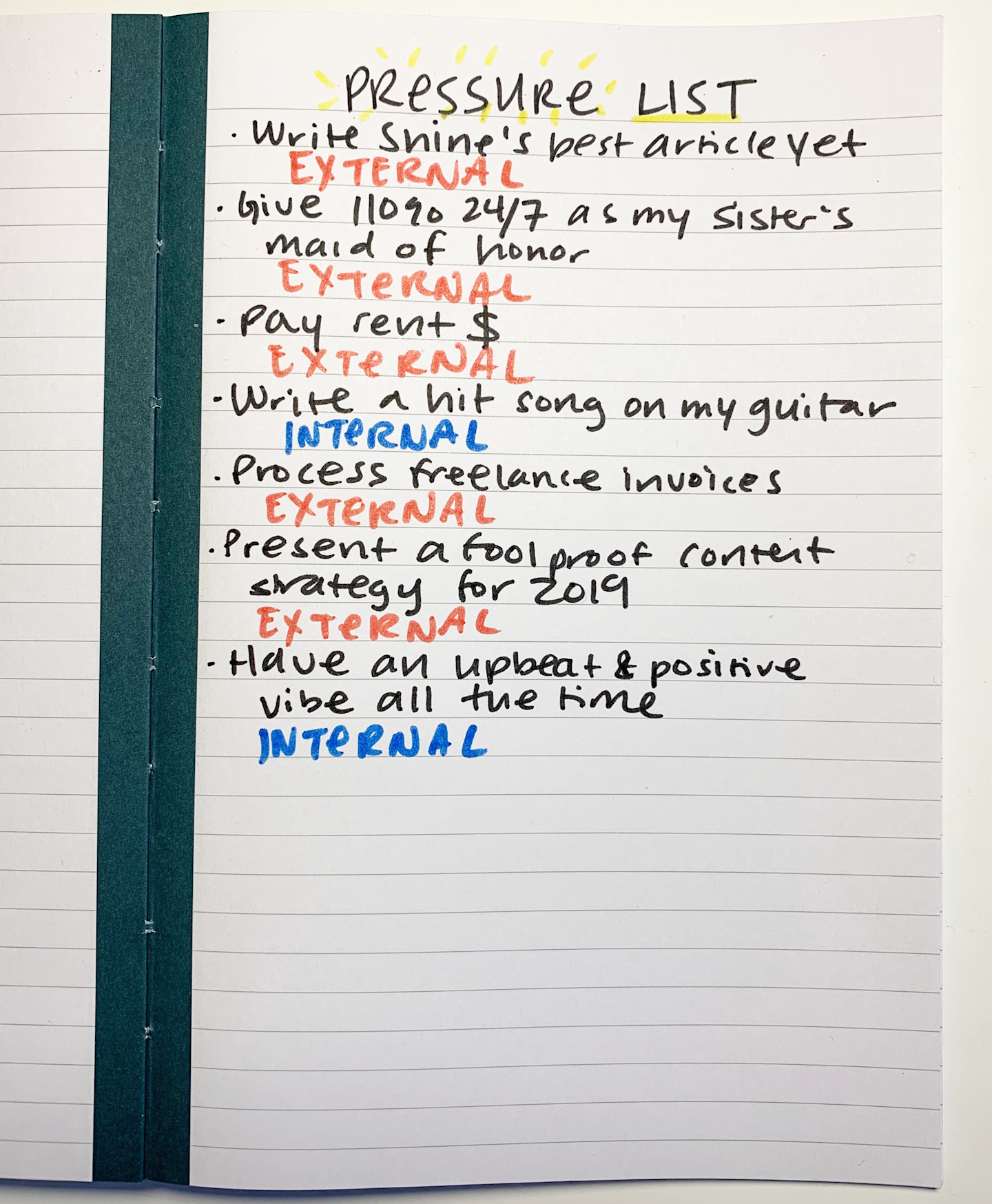
    From there, I labeled if the pressure felt external or internal. Some things could easily fall in both buckets, but I tried to pick just one to make the exercise easier (also: I tried to release the pressure to perfectly label everything as I did this).

    pressure-list-2Next came the fun part: I started to question if the pressure truly was real—or if it was fake or imagined.
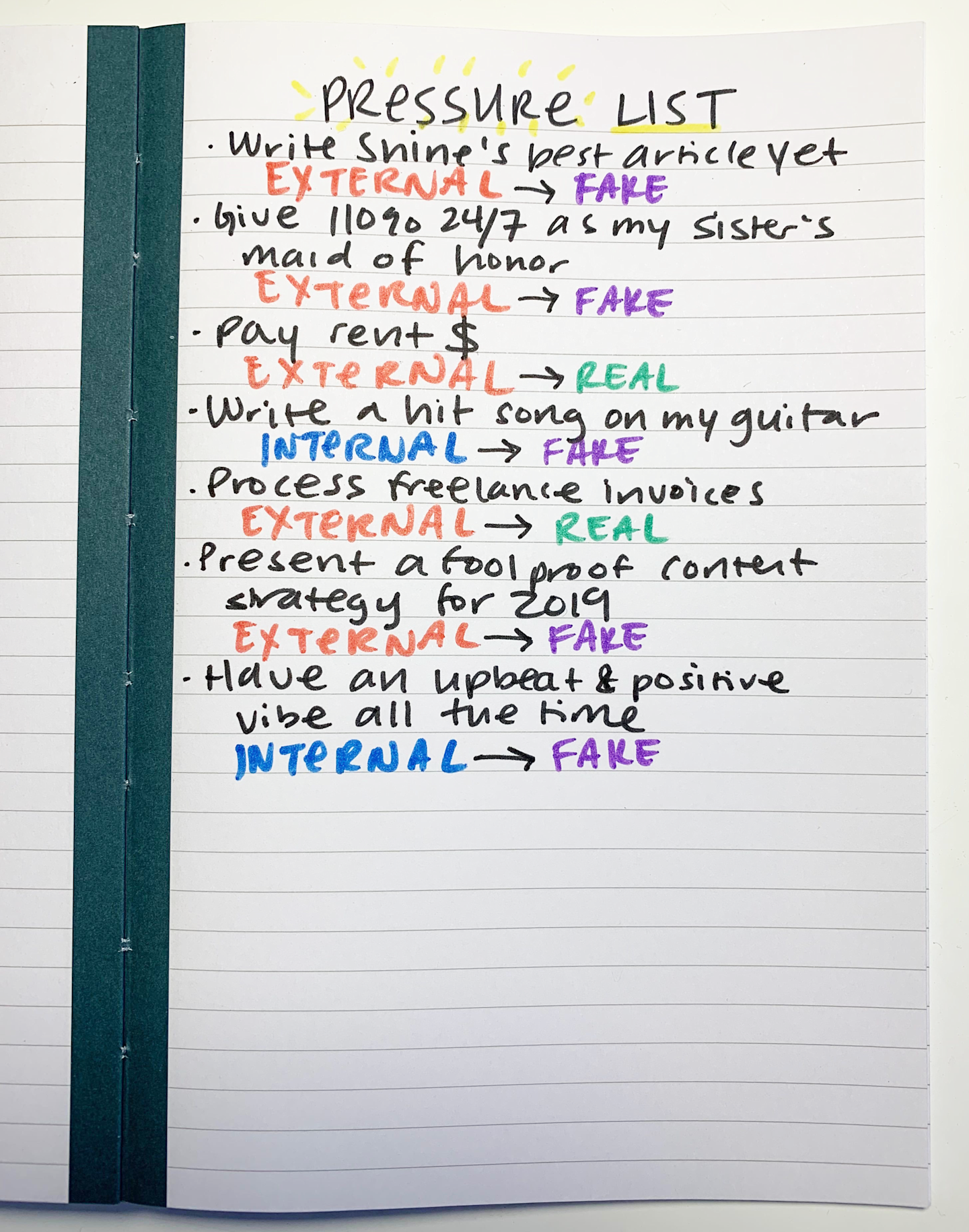
    With external pressure, I did this by asking myself: Does someone else really expect this of me? Or, could I be holding myself to a much higher expectation than actually exists?

    And when it came to internal pressure, I asked myself: Am I being too hard on myself by expecting this? Could I still be proud if I didn’t meet this expectation?

    I went through the items one by one and felt some of the stress start to release as I noticed a trend of fake pressure.

    pressure-list-3For example: “Write Shine’s best article yet.”

    Yes, I was on a deadline to write an article for the site. But did my team actually want the best article in the history of the Interwebs? Or, did they just want a solid piece that would resonate with our members?

    Next: “Give 110% 24/7 as my sister’s maid of honor.”

    Did my sister want me to do an amazing job as her maid of honor? Yes. Did she want it on my mind all hours of the day and night? Probably not.

    Some pressure was very real—I did need to process invoices and pay rent. But for some real tasks, I added fake stress by expecting perfection. For example: “Present a foolproof content strategy.” The only person in the office who expected perfection was me—so why put that pressure on myself?

    For some real tasks, I added fake stress by expecting perfection.
    Tweet

    And writing a hit song on my guitar? Creating that pressure was a quick way to kill one of my favorite hobbies.

    And then there was the straight-up fake pressure—I’m looking at you, “Have an upbeat & positive vibe all the time.” Sure, that’d be nice, but it’s not realistic to think I can operate on one emotion every single day. I’m not Siri.

    When I finished the exercise, I wish I could say that I suddenly felt zero pressure and as ear-steam-300x200free as a woman in a disposable razor commercial, acting as if she’s wearing shorts for the first time in her adult life. But we can’t fully get rid of pressure or stress. What we can do: Get curious about it and lessen the load.

    Overall, the exercise helped me start to untangle that elusive ball of stress I felt in the pit of my stomach.

    The exercise helped me start to untangle that elusive ball of stress I felt in the pit of my stomach.
    Tweet

    Next time you’re feeling under pressure, try a Pressure List and see if it helps you, too.

    And if that doesn’t work: At least we all have a theme song to get us through the most pressure-filled days.